You Didn’t Build These Agents. You Still Have to Govern Them.
Most enterprise AI agents come from someone else’s platform. Orchestrating and governing them is now your problem.
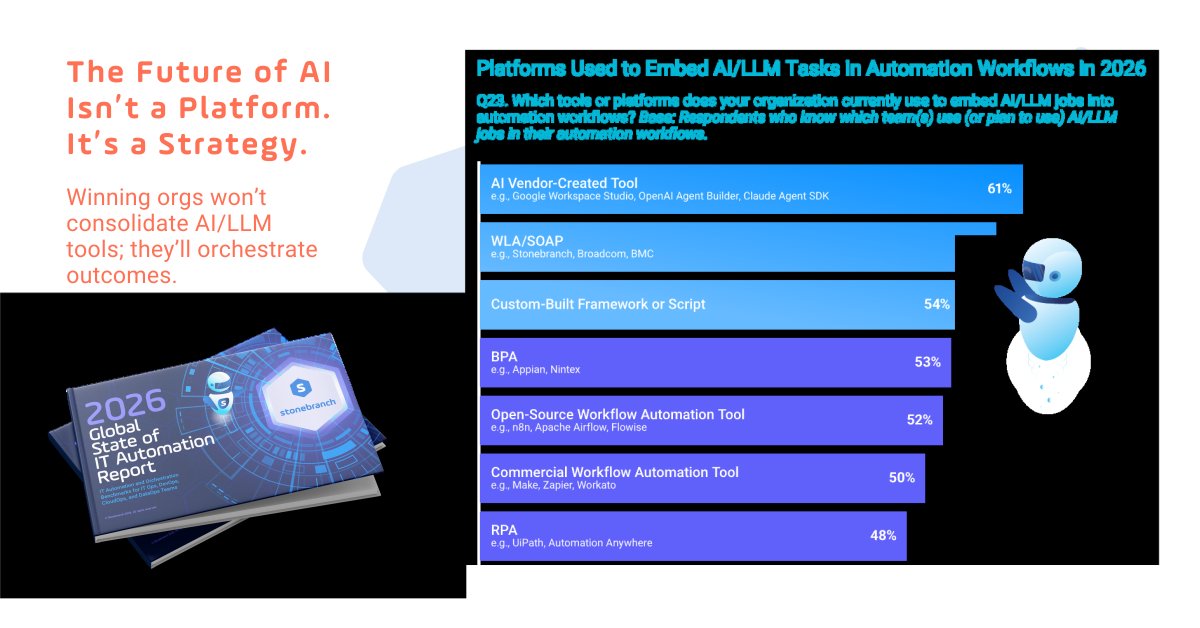
Walk into a large enterprise right now and count the AI agents. A coding assistant in engineering. A monitoring agent in operations. An analytics agent on the data team. A service bot in support. Most of them weren’t built in-house. According to the 2026 Global State of IT Automation Report, 61% of organizations use AI-vendor tools like OpenAI Agent Builder, the Claude Agent SDK, and Google Workspace Studio to put AI into their workflows, the single most common source of agents in the enterprise.
That creates a problem that the agent vendors do not solve. Each agent works well inside its own ecosystem. None of them coordinates with the others, and none of them answers to a single governance model. Within the enterprise, IT ops teams are typically accountable for what these agents do, which systems they touch, and whether their actions are safe, even though you didn’t build most of them.
This is the real AI agent governance challenge of 2026. Not building smarter agents. Coordinating and controlling the ones you already have.
Key Takeaways
- Most enterprise AI agents are bought, not built, so governing them is a coordination problem across vendors, not a build problem.
- Agent sprawl follows the same pattern as tool sprawl: independent adoption, then lost visibility.
- The orchestration layer that already coordinates your workloads is where agent governance belongs, because it’s the one place that sits above every vendor.
What Happens When Every Team Deploys Its Own Agents?
You get agent sprawl. It’s the uncontrolled spread of AI agents across teams with no central oversight, ownership, or governance, and it produces a fragmented environment where no one can say with confidence what every agent is doing.
Enterprises have seen this movie before. 89% already run multiple workload automation platforms, usually the result of mergers, departmental autonomy, and incremental adoption. Agents are repeating that pattern, only faster and with more autonomy. Development deploys coding agents. Operations adds monitoring agents. Data builds analytics agents. Business units spin up assistants. Each solves a real problem. Together, they create duplicate actions, conflicting decisions, and blind spots.
Adoption is already broad. On average, 56% of teams run AI/LLM jobs in their workflows today. The agents are here. The coordination isn’t.
Do AI Agents Replace Workload Automation and Orchestration?
No. Agents and orchestration do different jobs, and they need each other. Agents reason, decide, and act on specific tasks. Orchestration coordinates the broader workflow that connects systems, data, people, and approvals, and keeps the whole thing governed and reliable.
The market is already voting with its stack. When organizations embed AI into real work, 58% use a workload automation / SOAP platform to coordinate those AI/LLM tasks, second only to the AI-vendor tools themselves and ahead of custom scripts, business process automation, and RPA. Agents supply the intelligence. The orchestration layer provides the structure, dependencies, error handling, and audit trail that turn an agent’s decision into a safe production action.
An agent can decide to do something. Orchestration is what makes sure it happens in the right order, with the right data, under the right controls, and that you can prove it afterward.
The Agents Are Not the Hard Part. The Coordination Is.
A single capable agent is impressive. A workflow with five agents, three of them from different vendors, plus the legacy jobs and data pipelines they depend on, is where things break.
Consider a typical AI-driven flow. An event fires. An agent analyzes it. It pulls data from several systems. A second agent evaluates the result. A workflow runs an action. A human approves it. Downstream systems update. The intelligence of any one agent isn’t the issue. The friction is in everything happening around it.
That is why scale stays rare. 79% of organizations have yet to reach enterprise scale with AI/LLM workflows, with only 21% running enterprise-wide. And the reasons are operational, not aspirational. 92% report at least one barrier, led by integration challenges, skill and maturity gaps, and governance. This is a readiness problem, and readiness comes from a coordination layer, not from another agent.
How Do You Govern Agents You Didn’t Build?
You govern them at the layer that sits above all of them. Since most agents come from outside vendors, the only place to enforce consistent policy is the orchestration layer that connects every system and every tool, regardless of who made the agent.
Effective AI agent governance answers a fixed set of questions for every agent in your enterprise environment:
- Which agents are running, and who owns them?
- What systems and data can each one reach?
- What action is each one allowed to take?
- Who approved those permissions?
- What triggered a specific decision?
- How do we audit the outcome after the fact?
For regulated industries (financial services, healthcare, insurance, energy), those answers are mandatory. The advantage of governing at the orchestration layer is neutrality. It doesn’t matter whether the agent came from OpenAI, Anthropic, Google, or an internal team. They all route through the same workflows, approvals, and audit trail.
Keeping Humans in the Loop Without Slowing AI Down
Autonomy and oversight are not opposites. The organizations moving AI into production keep a human checkpoint exactly where risk is highest, and let everything else run.
This is already standard practice. 94% of organizations automate human process approvals or plan to in 2026. Approvals are the bridge that lets an agent act quickly on low-risk work while a person validates anything that touches production systems, customers, or financial records. Built into the workflow rather than bolted on, approvals keep AI-driven work governed and auditable without turning every decision into a meeting.
What Vendor-Neutral AI Orchestration Looks Like
The orchestration layer becomes the control plane for agents only if it’s neutral. The moment it favors one vendor’s agents, it stops being a coordination layer and becomes another silo.
Stonebranch Universal Automation Center (UAC) is built for that neutral position. It coordinates AI-powered tasks alongside traditional workloads, applications, and data pipelines across hybrid IT ecosystems, no matter where the agent or workload comes from. With UAC, organizations can:
- Run AI-powered tasks inside end-to-end workflows next to existing workloads and business processes, regardless of which vendor’s agent is involved.
- Coordinate actions across hybrid IT, including cloud, on-prem, containers, mainframe, and third-party applications.
- Trigger on real-time events so an agent’s decision sets off the right downstream actions instantly.
- Enforce governance with centralized visibility, auditing, approvals, and policy controls that apply to every agent equally.
- Keep humans in the loop with review and exception handling built into the workflow.
- Scale without creating disconnected automation silos.
This matters because 88% of enterprises run hybrid IT, so the control layer has to reach everything, and because the agents aren’t going to come from one place. The job isn’t to build the smartest agent. It’s to be the one layer that governs all of them.
Scaling AI from Pilot to Production
When you move away from disconnected AI tasks and focus on policy-driven orchestration, your technical teams can safely loop intelligent agents straight into daily operations. This keeps you from dealing with messy agent sprawl down the road.
Stonebranch UAC offers a solid foundation to connect AI experiments with production workflows. You get real-time visibility, centralized control, and clear human approval steps when you need them. Contact us to learn more.
Frequently Asked Questions
What is AI agent governance?
AI agent governance is the practice of controlling which AI agents can run, what they can access, what actions they can take, and how their decisions are approved and audited, across every agent in the organization regardless of which vendor built it.
How do you govern AI agents you didn’t build?
You govern them at the orchestration layer that connects all your systems. Because most agents come from outside vendors, the orchestration layer is the only neutral place to apply consistent permissions, approvals, and audit trails to every agent at once.
Do AI agents replace workload automation?
No. AI agents perform specific tasks and make decisions. Workload automation and orchestration coordinate the broader workflows that connect systems, data, and people, and keep the work governed and reliable. They are complementary, which is why 58% of organizations already use a workload automation or SOAP platform to coordinate their AI tasks.
What is agent sprawl?
Agent sprawl is the uncontrolled spread of AI agents across teams without central oversight. Organizations lose track of what agents are doing, what they access, and how their actions affect operations, the same way tool sprawl happens with multiple automation platforms.
How does Stonebranch help govern AI agents?
Stonebranch Universal Automation Center (UAC) coordinates AI-powered tasks alongside traditional workloads across hybrid IT, applying centralized visibility, approvals, auditing, and policy controls to every agent regardless of which vendor created it.
Author

Scott Davis
Chief Marketing Officer
Scott Davis is Chief Marketing Officer at Stonebranch, where he leads global brand, product marketing, demand generation, and corporate communications. He brings 20+ years of B2B SaaS marketing experience, with prior senior leadership roles at SAP and Calero Software.