
Stonebranch Feature
Robi AI
AI-Powered Intelligence for Universal Automation Center
Robi AI brings governed, AI-powered intelligence to the Universal Automation Center, enabling intelligent workflows, natural-language automation, and AI-driven troubleshooting and remediation — all while maintaining the governance, guardrails, and deterministic control enterprises require.
Re-Imagine IT Automation as
Intelligent Orchestration
Robi AI brings AI-powered intelligence to Stonebranch Universal Automation Center (UAC), transforming complex automation environments into systems that teams can build, understand, and optimize using natural language and real-time AI-driven insights.
Faster automation creation with natural language and AI assistance
- Smarter troubleshooting through real-time insights and recommendations
- More capable workflows with embedded AI-driven tasks
- Built-in governance with guardrails for security, reliability, and compliance
- Broader access by enabling more teams to create and manage automation
The Three Pillars of Robi AI
Reduce Complexity. Accelerate Troubleshooting. Democratize Automation.
Robi AI is organized around three core capabilities — each designed to make automation more accessible, more intelligent, and more powerful.
Create Faster
Build
Accelerate automation with AI. Design workflows, scripts, and pipelines using natural language — no deep expertise required.
- Access documentation with a context-aware AI assistant
- Generate scripts and extensions with AI
- Build workflows with AI
Best for teams that want to reduce technical barriers and speed up automation design.
Operate Smarter
Run
Optimize operations with AI-driven insights. Analyze failures, simplify complexity, and resolve issues faster.
- Identify root causes of job failures instantly
- Embed AI directly into workflows
- Turn technical logs into clear insights
Best for operations teams that need faster troubleshooting and clearer workflow visibility.
Connect Openly
Integrate
Connect AI, systems, and workflows seamlessly. Use open standards to enable interoperability — without vendor lock-in.
- Connect systems with an MCP client/server
- Build and extend AI capabilities
- Enable self-service automation from LLMs
Best for enterprises that need scalable AI interoperability across tools and teams.
Build: Robi AI Assistant
Accelerate Onboarding and Adoption with Conversational AI
Robi AI is a chat-based knowledge assistant trained on UAC's metadata, documentation, and your live environment state. Users can query, trigger, and troubleshoot automation workflows in plain language — no scripting required.
- Connects via secure APIs to retrieve and manage automation objects (tasks, workflows, triggers, agents, variables)
- Enable users to trigger automation executions directly from chat
- Query current and historical status of tasks, workflows, and triggers
- Support operational actions: cancel, force-finish, hold, skip, and rerun
- Ask natural language "how-to" questions and return steps or links to documentation
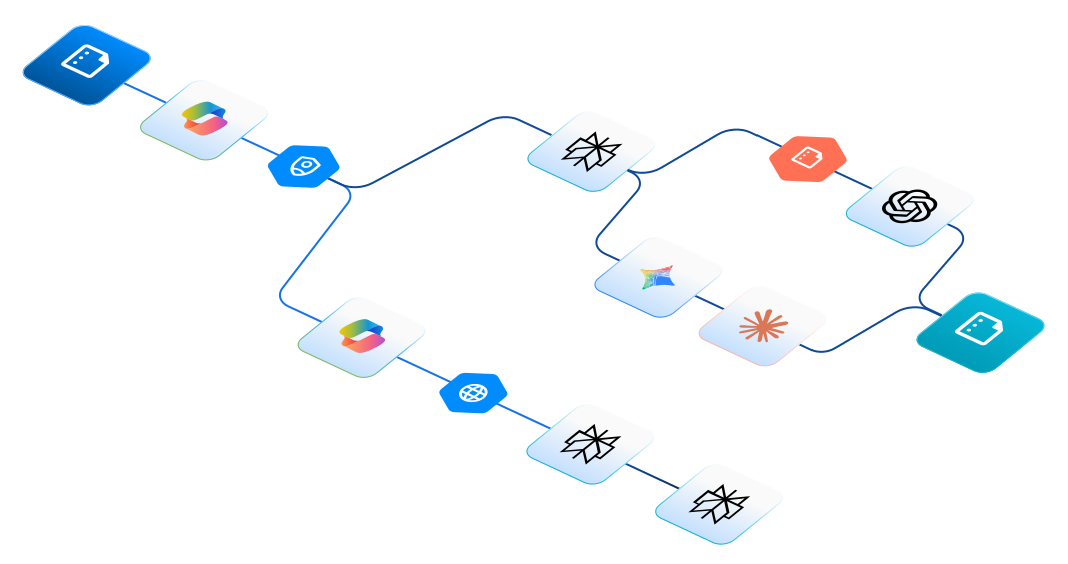
Run: AI Workflow Automation
Put AI Inside Your Workflows — Keep Humans in Control
Embed AI directly into automation workflows as a governed step — not as an unchecked decision-maker. Create hybrid deterministic and probabilistic workflows to automate unstructured or cognitive tasks.
Essential Control Plane for AI Orchestration
- Human-in-the-Loop: Decision support with AI-generated context packages
- UAC System Prompt Library: Role-restricted write access; standard users can invoke system prompts but cannot edit or delete them
- Prompt Integrity: System prompt instructions are as protected as any privileged system config
- Output Predictability: Schema instructions enforce structured, parsable responses that downstream tasks can act on without human review
Run: Intelligent Job Failure Analysis
Instant Root Cause Analysis and Remediation
Resolve incidents faster with AI-driven analysis and recommendations. Robi AI analyzes logs, job metadata, and execution history to explain failures, recommend fixes, and optionally apply remediation steps — all within UAC's governed framework.
- Analyze logs and diagnostics for specific tasks or workflows
- Retrieve audit records and dependency information automatically
- Provide access to start time, end time, exit code, and high-level result messages
- Summarize complex automation environments — dependencies, workflow behavior, operational status
- Leverage AI to automatically perform remediation steps after analysis
Integrate: MCP Client/Server
AI Interoperability and Self-Service Automation
Use LLMs as the front end for enterprise automation. Stonebranch enables AI-driven self-service, allowing users to interact with the Universal Automation Center through large language models using natural language.
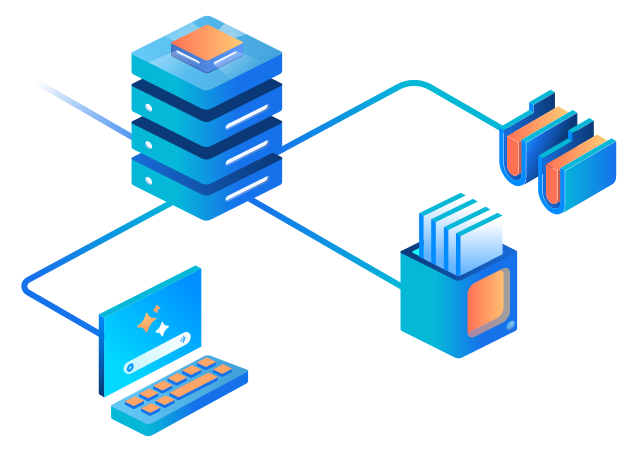
Use Conversational AI as the Interface to Enterprise Automation
Leverage genAI platforms like Claude, Gemini, and ChatGPT as a self-service interface to enterprise automation. Enable both human users and AI agents to access orchestration capabilities in UAC through natural language.
- Unified Connectivity: Integrate AI models and agents through the Model Context Protocol (MCP) and API-based AI gateways — no custom integrations required.
- Agent-to-Agent Orchestration: Enable AI agents to securely communicate, exchange context, and trigger automated workflows across your enterprise.
- Open AI Ecosystem: Prevent vendor lock-in by supporting proprietary and other AI applications with interoperable frameworks.
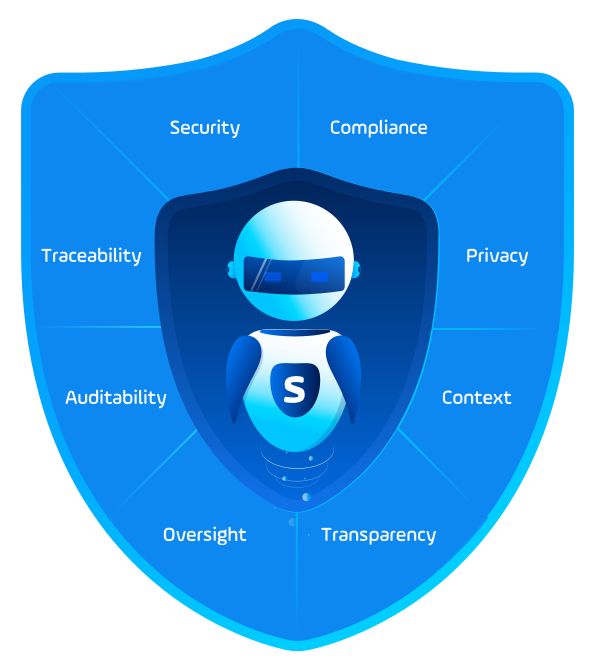
Governance and Guardrails
Trusted AI Starts with Governed Automation.
Robi AI is built with governance at its core — not added later.
Enterprises do not just want AI. They want AI they can trust. Robi AI delivers intelligent capabilities inside a structured, policy-driven control framework.
Access
Secure Access From the Start
- SAML/OAuth authentication tied directly to UAC
- Strict role-based authorization
- No permissions inherited outside UAC
Governance
Built for Policy-Driven Control
- Governed, versioned system prompt library
- Role-restricted prompt management
- Capability restrictions by role, workflow, or environment
Auditability
Visibility Into Every AI Action
- Audit user logins, API calls, and AI interactions
- Track user actions end to end
- Support reliability, compliance, and oversight
Intelligent Automation Works Best When Governance is Built Into the Foundation.
Security First Architecture
Enterprise-grade data privacy built into every layer of Robi AI
- Zero data retention for training
- Private deployment options
- Full model and integration control
- Enterprise compliance ready
Enterprise security
Private and Secure by Design
Robi AI is designed for enterprise security and data privacy. This architecture ensures enterprises maintain complete ownership of data and AI usage.
- No customer data used for AI training — your workflows and data stay yours
- Private AI server deployment options — full control over where AI runs
- SaaS, hybrid, or self-managed environments — flexible to your security posture
- Full control over AI models and integrations — no black boxes in your stack
The Advantages of Robi AI
Robi AI delivers measurable impact across the full automation lifecycle — from development to operations to expansion.

Instant Root Cause
Analysis and Remediation
Resolve incidents faster with AI-driven analysis and recommendations. Then leverage AI to automatically perform remediation steps.

Embed AI Tasks
Into Workflows
Enable the automation of unstructured or cognitive tasks in UAC. Create hybrid deterministic and probabilistic workflows to support new use cases.

AI That Fits
Your Rules
Maintain full control over AI capabilities, including the ability to turn them off, govern usage, restrict actions by role or environment, and deploy in SaaS or self-managed environments.

AI-Assisted
Workflow Development
Create automation workflows faster with AI. Design workflows, scripts, and create automation pipelines with natural language.

Accelerate Onboarding
and Adoption
Democratize operational knowledge with a chat-based knowledge assistant trained on UAC’s metadata, documentation, and environment state.

Data
Privacy
Every customer has their own instance of Robi AI. Your data is private and secure, and Stonebranch does not use customer data to train Robi AI.
Universal Automation Center
Core Pillars of Universal Automation Center
Learn more about Stonebranch's service orchestration and automation platform capabilities by exploring UAC's core pillars — designed to extend and enhance your AI-powered workflow automation strategy.
Event-Driven Automation
Trigger workflows in real-time from system events.
Learn moreAnalytics & Observability
Gain visibility and access to metric, trace, and log data.
Learn moreSelf-Service Automation
Enable access to your centrally governed automation platform.
Learn moreInfrastructure & Service Automation
Orchestrate on-prem and cloud infrastructure.
Learn moreIT Workflow Automation
Visually create and manage automated workflows with AI.
Learn moreExplore Additional AI Automation Resources

Frequently Asked Questions
How does UAC ensure secure access and permissions?
UAC uses authenticated user identities to enforce platform permissions and data segmentation. This ensures users can only access and execute what they are authorized to.
Can users perform actions they’re not authorized for?
No. UAC prevents execution of any automation actions that fall outside a user’s permissions, protecting systems and workflows from unauthorized activity.
How is sensitive documentation protected?
Access to proprietary documentation is restricted to authorized users only, ensuring internal resources remain secure and controlled.
Can users trigger automation directly from chat?
Yes. Users can initiate workflows, launch tasks, or trigger events directly through conversational interactions.
Can Robi AI provide operational insights?
Robi AI allows users to query both real-time and historical status of automation processes, including workflows and triggers.
What operational actions can Robi AI perform?
Authorized users can execute actions like canceling, rerunning, holding, skipping, or force-finishing automation tasks.
What kind of operational details can users access?
Robi AI provides key execution data, including start and end times, duration, exit codes, and high-level results.
How does UAC support troubleshooting and root cause analysis?
UAC provides access to logs and diagnostic data for specific tasks and workflows, enabling faster troubleshooting and root cause identification.
How does documentation support work within the platform?
Users can search, extract, and interpret Stonebranch documentation — including APIs, task definitions, and workflow setup guides — directly within the platform.
Can users ask questions in natural language?
Yes. Users can ask “how-to” questions and receive step-by-step guidance or links to relevant documentation.
What is AI workflow automation in UAC?
AI workflow automation enables users to embed AI tasks directly into workflows, moving from rigid, rule-based automation to adaptive, intelligent systems that can handle unstructured data and make decisions with minimal human intervention. AI tasks leverage governed, reusable system prompts that standardize how automation logic and responses are generated.
How are system prompts managed?
System prompts are stored in a centralized library and treated as reusable assets rather than one-off inputs.
Who can modify system prompts?
System prompts are role-restricted. Most users can use them, but only authorized users can edit or manage them.
How does UAC ensure consistent AI responses?
Schema-driven instructions define how outputs are structured, ensuring consistent, predictable responses instead of free-form outputs.