Employee Onboarding and Offboarding Workflow Pattern: Orchestrating the Hire-to-Retire Lifecycle
Orchestrate hire-to-retire processes across hybrid IT environments with event-driven automation, centralized governance, and full lifecycle visibility.
What this post covers: This article provides a concrete workflow pattern for employee onboarding and offboarding using Stonebranch Universal Automation Center (UAC), based on Stonebranch’s own internal implementation. It focuses on enterprise business application automation as a reference architecture for IT operations and automation teams — not as a step-by-step HR onboarding guide or platform comparison.
Hire-to-retire is often described as an HR lifecycle process. In reality, it’s a cross-functional orchestration challenge that spans the entire enterprise technology landscape.
Every employee lifecycle event — onboarding, role change, transfer, leave, or offboarding — touches multiple business applications and multiple departments.
Without coordinated automation, these transitions often rely on manual handoffs, disconnected workflows, email chains, and ticket-based coordination. In hybrid IT environments, where applications run across on-premises infrastructure, cloud platforms, SaaS environments, and containerized services, the complexity multiplies.
This reflects a broader enterprise reality: the 2026 Stonebranch Global State of IT Automation Report found that 88% of enterprises operate hybrid IT environments, increasing the need for centralized orchestration across systems
Key Takeaways
- Hire-to-retire extends beyond HR and becomes an enterprise-wide orchestration challenge.
- HR platforms like Workday, SAP SuccessFactors, Oracle HCM, and Microsoft Dynamics 365 Human Resources effectively manage HR workflows, but employee lifecycle events often impact IT, finance, identity, security, and other business systems.
- An orchestration layer connects HR systems with ITSM tools, identity platforms, CRM, ERP, LMS, payroll, and cloud services to ensure seamless execution.
- UAC helps eliminate manual handoffs, reduce tool sprawl, and centralize automation across systems.
- Automating onboarding enhances the employee experience, while automating offboarding improves governance, security, and auditability.
What Is Employee Onboarding and Offboarding Automation?
Employee onboarding automation coordinates the systems, applications, access rights, and approvals required when a new employee joins an organization. Employee offboarding automation reverses that process: removing access, revoking licenses, retaining data where required, and notifying stakeholders when an employee leaves.
Together, onboarding and offboarding form critical parts of the broader hire-to-retire lifecycle. Hire-to-retire describes the complete journey of an employee within an organization, from recruitment and onboarding through role changes, internal transfers, access updates, training requirements, compensation changes, and eventual departure.
Why Automate Employee Onboarding and Offboarding?
Many organizations use HR platforms (such as Workday, SAP SuccessFactors, Oracle HCM, and Microsoft Dynamics 365 Human Resources) to structure onboarding tasks, trigger internal workflows, manage compliance, and track employment status.
However, once a candidate signs an employment contract, the process no longer belongs solely to HR. That single event can trigger updates across:
HR systems, identity and access management platforms, IT service management tools, CRM and ERP applications, learning management systems, payroll and finance tools, cloud infrastructure, and SaaS platforms.
While HR tools can trigger workflows and integrate with selected systems, hybrid IT environments require coordination across a broader enterprise landscape.
Stonebranch UAC adds a layer of orchestration to automate the full business process across departments while maintaining governance, hybrid IT awareness, and full lifecycle visibility.
Workflow Pattern: Employee Onboarding and Offboarding
This workflow pattern shows how organizations can use Stonebranch UAC to orchestrate employee onboarding and offboarding as part of a broader hire-to-retire lifecycle.
From HR Event to Enterprise Workflow
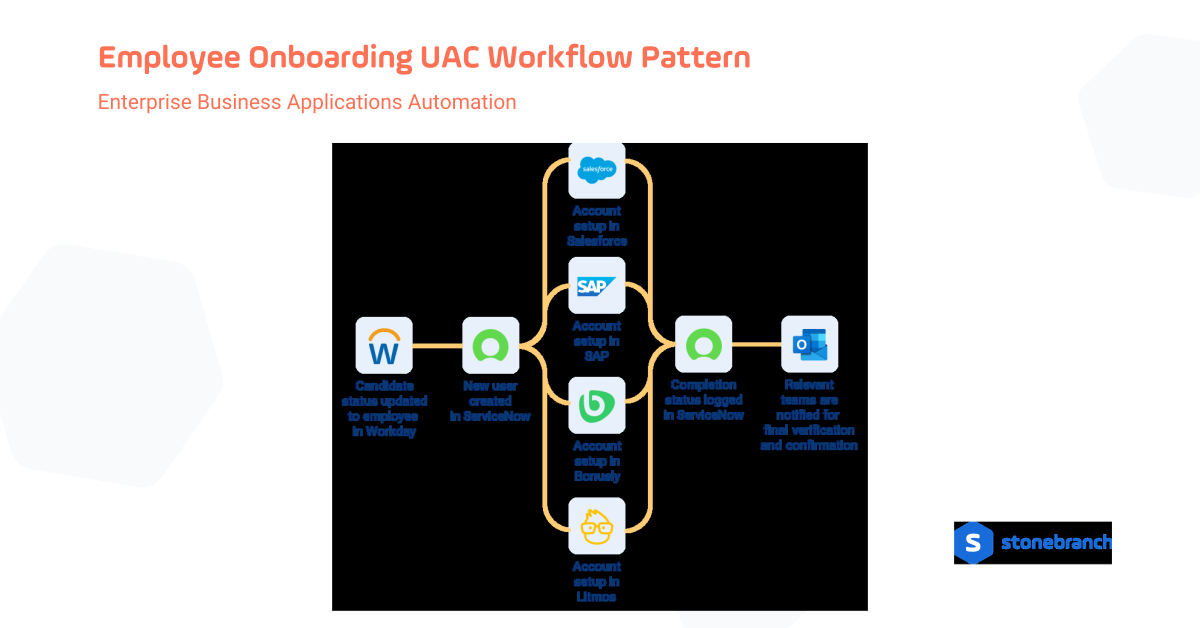
In this simplified example, the process begins when a candidate completes the recruitment process in Workday and accepts the offer. This lifecycle event triggers the onboarding process: a new user record is created in, for example, ServiceNow, where the ticket acts as the operational reference point for the workflow.
From that point, UAC coordinates the setup of accounts and access across applications such as Salesforce, SAP, Bonusly, and the learning platform. Once the required actions are complete, the workflow updates the originating system and notifies the relevant teams.
From Workflow Pattern to UAC Execution
The simplified pattern is easy to understand, but the real value becomes clear when you look at the execution layer. The following example reflects the real-life onboarding workflow used by Stonebranch:
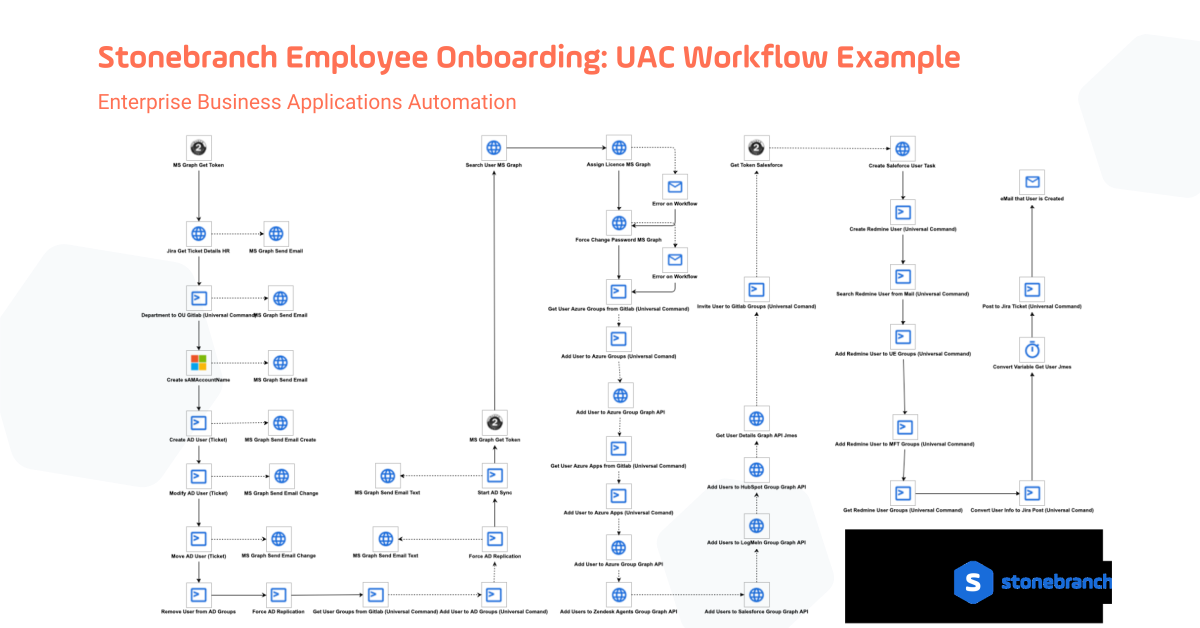
In Stonebranch’s internal process, UAC reads the Jira ticket and uses it as the source of instructions. The ticket defines which applications, systems, and access rights need to be created for the employee.
UAC then executes the required workflow steps. It can provision a user identity in Entra or Active Directory, configure email access, assign CRM and ERP licenses, enroll the employee in learning systems, and trigger additional application setup based on role or department.
This isn’t a static onboarding template. It’s a flexible workflow pattern that organizations can adapt to their own systems, approval logic, policies, and hybrid IT environment.
Employee Offboarding as a Governed Workflow
A similar orchestration logic applies when an employee leaves the organization.
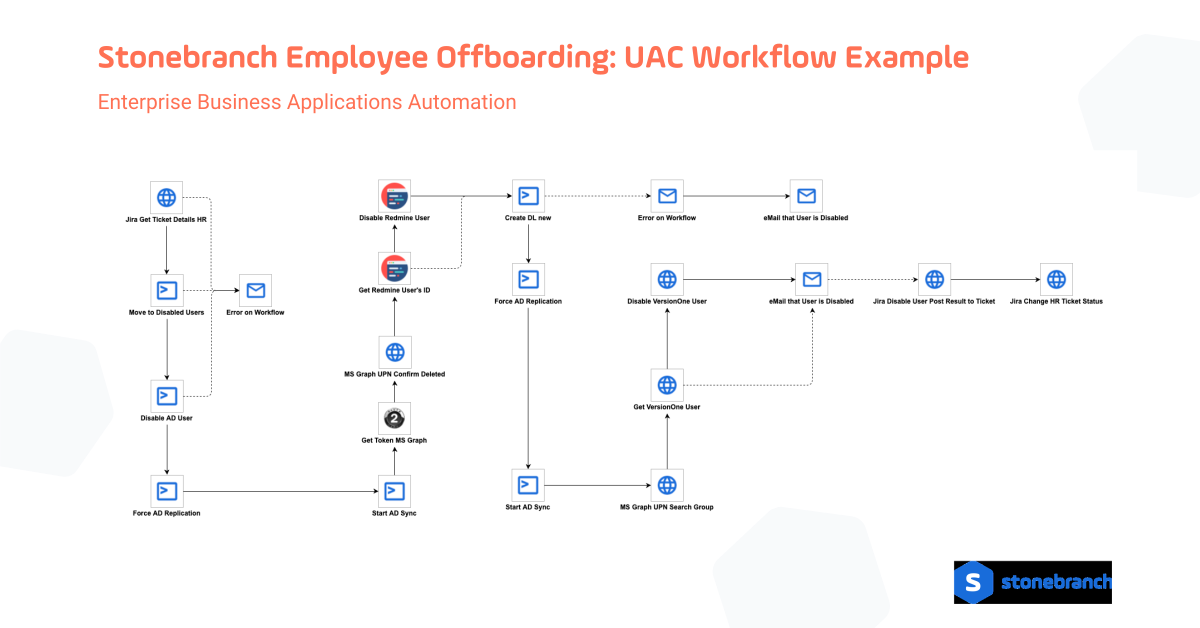
A status change can trigger a reverse lifecycle workflow. UAC removes access from Entra or Active Directory, revokes application licenses, forwards email as required, preserves storage in accordance with policy, and ensures that related systems reflect the updated employee status.
This is where orchestration becomes especially important. Offboarding isn’t just an administrative process. It’s also a security and governance event. Licenses are managed automatically, ensuring allocations remain accurate and up to date across systems.
With UAC, what previously required manual coordination across departments becomes a governed, event-driven process executed from a centralized control layer.
Centralized Control Across the Employee Lifecycle
The value of this pattern isn’t limited to employee onboarding or offboarding. It provides a blueprint to orchestrate the full hire-to-retire lifecycle.
As employees move through an organization, lifecycle events continue to trigger operational requirements, such as:
- Role changes may require new permissions and application access.
- Internal transfers may require different system configurations by department or region.
- Training requirements may need to update when certifications expire or regulations change.
- Compensation changes may need to connect with finance and payroll systems.
- Temporary access may need to be granted and revoked on a defined schedule.
UAC helps connect these events into a single enterprise automation strategy. It gives IT and business teams centralized visibility into workflow execution while allowing each organization to tailor the process to its own needs.
That’s the broader value of enterprise business application automation: it turns employee lifecycle events into connected, governed, and monitored workflows across the enterprise.
Watch the Workflow Pattern in Action
The following video walks through the employee onboarding and offboarding workflow pattern in UAC. It shows how lifecycle events can trigger coordinated workflows across business applications, and how this pattern can be adapted to support enterprise-specific processes.
Conclusion
Employee onboarding and offboarding are familiar processes, but in modern enterprises, they’re no longer simple HR workflows. They’re business-critical lifecycle events that affect identity, access, applications, finance, security, and operations.
HR platforms provide the foundation for managing employee data and HR processes. UAC extends that foundation by orchestrating downstream actions across the enterprise application landscape.
With a centralized orchestration layer, organizations can automate employee lifecycle events in a way that’s flexible, event-driven, governed, and visible. Onboarding and offboarding are strong starting points — and the same pattern can serve as a blueprint for orchestrating the full hire-to-retire lifecycle.
Want to learn about additional workflow patterns? Check out these customer favorites: CRM Trigger for Self-Service Workflows, CRM and ERP Orchestration Workflow pattern, and the Disaster Recovery Failover Workflow pattern.
FAQ
What is employee onboarding automation?
Employee onboarding automation coordinates the systems, applications, access rights, and approvals required when a new employee joins an organization. It goes beyond HR workflows to include identity provisioning, application licensing, and cross-system notifications.
What is employee offboarding automation?
Employee offboarding automation manages access removal, license revocation, data retention, and stakeholder notifications when an employee leaves. Automated offboarding reduces the risk of orphaned accounts and ensures compliance with data retention policies.
What is hire-to-retire automation?
Hire-to-retire automation covers the complete employee lifecycle: from recruitment and onboarding through role changes, transfers, training updates, compensation changes, and eventual offboarding. It treats each lifecycle event as a trigger for coordinated workflows across enterprise systems.
Why is orchestration important for onboarding and offboarding?
Orchestration helps coordinate actions across multiple systems, departments, and environments while maintaining visibility, governance, and control.
Can this workflow pattern be customized?
Yes. The workflow pattern is designed to be adapted to different roles, departments, applications, policies, and hybrid IT environments. UAC supports conditional logic, role-based branching, and event-driven triggers that let organizations tailor the pattern to their specific requirements.
Author

Nefer Lind
Content Marketing Manager
Nefer Lind is a content-driven marketer who supports content creation for the Stonebranch community to get the most out of their digital transformation initiatives. Previously, she worked in marketing at HONICO (now part of Stonebranch) with a strong focus on SAP workload automation and held commercial roles with international fashion brands. Nefer holds a diploma in International Management (Diplom-Kauffrau) from Hamburg University of Applied Sciences, Germany.