AI Workflow Orchestration: Why SOAP is the Essential AI Control Plane
Learn how AI workflow orchestration enables scalable automation and why service orchestration and automation platforms (SOAP) provide the reliability, control, and governance enterprises need to operationalize AI.
AI workflow orchestration is quickly becoming a critical capability for enterprises looking to move beyond experimentation and into production.
While many organizations are successfully piloting AI use cases, far fewer are scaling them. The reason is simple: AI requires an AI control plane to orchestrate and deliver consistent, reliable business outcomes.
That’s where SOAP (service orchestration and automation platforms) comes in. As the modern evolution of workload automation, SOAPs are purpose-built to bring control, reliability, and scalability to complex, cross-system automation processes.
If AI is the brain, SOAP is the nervous system that makes it usable at enterprise scale.
The Growing Importance of AI Workflow Orchestration
Early AI workflows are often simple:
- Trigger an event
- Call a large language model (LLM)
- Execute an action
But as adoption grows, these workflows become significantly more complex:
- Multiple AI model interactions
- Data integrations and dependencies across systems
- Conditional logic and approvals
- Integration with enterprise applications (CRM & ERP, and data platforms)
- Monitoring, retries, and error handling
At this stage, organizations need more than automation — they need AI workflow orchestration.
What Is AI Workflow Orchestration?
AI workflow orchestration is the process of coordinating AI models, data flows, application tasks, infrastructure, and business logic into a unified, end-to-end workflow.
It ensures that:
- Each step executes in the correct order
- Dependencies are managed
- Failures are handled swiftly
- Outcomes are observable and auditable
Without orchestration, AI workflows remain fragmented and difficult to scale.
Why SOAPs Are Perfect as the Essential Control Plane for AI Workflow Orchestration
SOAP platforms are designed for complexity. They don’t just automate tasks. Rather, they orchestrate entire workflows across systems, environments, and timeframes.
According to the 2026 Global State of IT Automation report, SOAPs are the second-most-popular choice for AI workflow orchestration. First on the list are AI vendor-created tools like Google Workspace Studio and OpenAI Agent Builder.
Platforms Used to Embed AI/LLM Tasks in Automation Workflows in 2026
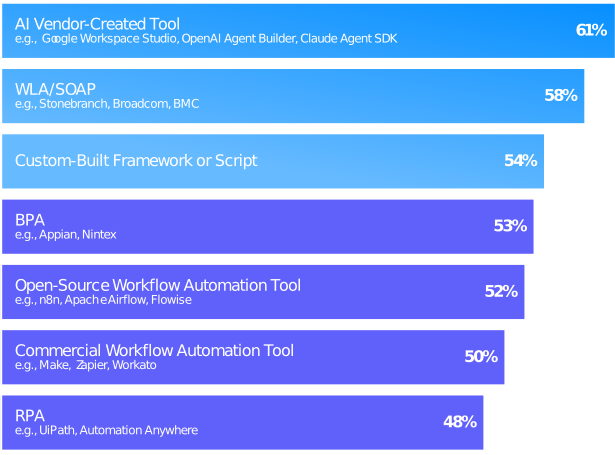
Of course, vendor-created AI orchestration tools are narrowly focused on their own ecosystems and will not be helpful for hybrid or multi-AI model orchestration.
As a result, SOAPs are considered the best choice as the essential AI control plane because they offer:
- End-to-end orchestration for AI pipelines
- Reliability in a non-deterministic world
- Deep observability and auditability
- Hybrid and cross-system execution
- Unified control of batch + real-time AI
- Governance and enterprise-grade security
- AI guardrails to control outcomes
Below, we’ll drill into each of these points.
1. End-to-End Orchestration for AI Pipelines
AI workflows rarely live in isolation. They’re part of broader business processes that include:
- Data ingestion and preprocessing
- Model execution, e.g., LLMs and machine learning (ML) models
- Post-processing and validation
- System updates and downstream triggers
SOAPs coordinate all of this in a single, unified workflow — handling sequencing, dependencies, and execution logic.
Instead of stitching together disconnected automations, you get a cohesive, managed pipeline or workflow.
2. Reliability in a Non-Deterministic World
AI introduces uncertainty. Outputs can vary. APIs can fail. Data can be incomplete.
That makes orchestration reliability more important than ever.
SOAP platforms provide:
- Built-in retry logic
- Dependency management
- Failure handling and escalation
- SLA enforcement
This ensures that even when an AI system behaves unpredictably, the workflow itself remains stable and controlled.
3. Deep Observability and Auditability
One of the biggest risks in implementing AI capabilities is a lack of visibility:
- What happened when something failed?
- Which model produced this output?
- What data was used?
SOAP platforms offer:
- Centralized monitoring
- Detailed logs and execution traces
- Audit trails for compliance
This is critical for debugging, governance, and trust — especially in regulated environments.
4. Hybrid and Cross-System Execution
AI workflows don’t live in one place. They span:
- Cloud services (LLMs, APIs)
- On-prem systems (ERP, data sources)
- Containers and data pipelines
SOAP platforms are built to seamlessly orchestrate across all of these environments.
That makes them ideal for organizations with complex, hybrid architectures, where data and processes are distributed.
5. Unified Control of Batch + Real-Time AI
AI use cases often require both:
- Real-time workflows (e.g., classify a support ticket instantly)
- Batch processes (e.g., retrain models, run nightly enrichment jobs)
SOAP platforms unify both paradigms into a single orchestration layer — so you’re not managing separate systems for real-time event-driven and scheduled automation.
6. Governance and Enterprise-Grade Security
As AI moves from experimentation to production, governance becomes non-negotiable.
SOAP platforms provide:
- Role-based access control (RBAC)
- Credential and secrets management
- Full auditability
This allows organizations to scale AI responsibly, without sacrificing security or compliance.
7. AI Guardrails to Control Outcomes
SOAPs use built-in AI guardrails to drive more predictable answers.
SOAP platforms enable:
- Centralized system prompt control
- User prompt control
- Schema instructions
These controls enable more deterministic outcomes from what are typically probabilistic answers.
Deep Dive on Guardrails for AI Orchestration
AI guardrails are very important for workflows deployed to production environments.
Why? At its core, AI is considered probabilistic. In practical terms, this means that without specific guardrails, AI answers are directionally the same, but not identical, each time they’re produced.
With an AI workflow orchestration platform like a SOAP, you’re combining probabilistic and deterministic tasks. This creates a potential pitfall for operations teams that require precise outcomes from their automated workflows.
This is where SOAP adds tremendous value. To expand on point seven above, SOAPs allow every AI task invocation to flow through three distinct control layers:
- System prompts: Defines what the LLM is allowed to do, how it should respond, and what constraints it must respect.
- User prompts: Carries the actual payload for each execution — variables, file content, structured text, or any combination. This is the dynamic, per-run data the model works with.
- Schema instructions: Tells the LLM how to structure the response. The model fills a defined template rather than composing freely.
Final Thoughts: AI Workflow Orchestration is the Key to Scale
AI is only as powerful as the workflows it powers.
Without orchestration, AI initiatives remain siloed, fragile, and difficult to scale. With the right orchestration frameworks, they become reliable, repeatable, and impactful.
SOAP platforms provide the control, visibility, and scalability required for enterprise AI workflow orchestration.
As organizations move from experimentation to production, one thing is clear:
AI workflow orchestration isn’t optional — it’s foundational. And SOAP platforms are what make it possible.
Frequently Asked Questions
How do you know when your organization is ready for AI workflow orchestration?
You’re likely ready when:
- AI pilots are successful but difficult to scale
- Teams are manually stitching together workflows
- Failures or inconsistencies are increasing
- There’s a need for governance, auditability, or compliance
At this point, orchestration becomes a necessity rather than a nice-to-have.
What are common signs that AI workflows are breaking down?
Typical warning signs include:
- Frequent manual intervention to fix workflows
- Inconsistent AI outputs are impacting downstream systems
- Lack of visibility into failures
- Duplicate or redundant automations across teams
These issues often indicate a missing orchestration layer.
Who typically owns AI workflow orchestration within an enterprise?
Ownership usually spans multiple teams:
- IT / platform teams: infrastructure and orchestration
- Data / AI teams: models and pipelines
- Business teams: use cases and outcomes
SOAP platforms help unify these stakeholders under a shared control plane.
How does orchestration improve collaboration between teams?
By providing a centralized workflow layer, orchestration:
- Creates a shared system of record for automation
- Reduces silos between AI, IT, and business teams
- Enables clearer handoffs and accountability
This alignment is critical for scaling AI initiatives.
What role does orchestration play in AI cost management?
Without orchestration, costs can spiral due to:
- Redundant model calls
- Inefficient workflows
- Uncontrolled API usage
Orchestration introduces control mechanisms that optimize execution and reduce unnecessary compute spend.
Can AI workflow orchestration help with model switching or vendor flexibility?
Yes. A strong orchestration layer abstracts the workflow from the underlying AI agent or model, making it easier to:
- Swap LLM providers
- Use multiple models for different tasks
- Avoid vendor lock-in
This flexibility is critical in a rapidly evolving AI application landscape.
What’s the difference between automation and orchestration in practical terms?
- Automation focuses on individual tasks
- Orchestration manages how those tasks work together
In AI, this distinction matters because isolated automations can’t handle the complexity of real-world workflows.
How do SOAP platforms support the continuous improvement of AI workflows?
They enable iteration by:
- Capturing detailed execution data
- Allowing workflows to be updated without disruption
- Supporting versioning and testing
This creates a feedback loop for optimizing performance over time.
What are the risks of scaling AI without a control plane?
Key risks include:
- Workflow failures impacting business operations
- Lack of accountability for AI decisions
- Security and compliance gaps
- Increased technical debt
A control plane mitigates these risks by centralizing control and visibility.
How does orchestration help future-proof AI investments?
By decoupling workflows from specific tools or models, orchestration:
- Enables easier adoption of new technologies
- Reduces rework when systems change
- Provides a stable foundation as AI tools evolve
This ensures long-term ROI on AI initiatives.
Author

Scott Davis
Chief Marketing Officer
Scott Davis is Chief Marketing Officer at Stonebranch, where he leads global brand, product marketing, demand generation, and corporate communications. He brings 20+ years of B2B SaaS marketing experience, with prior senior leadership roles at SAP and Calero Software.