Infrastructure Automation and Orchestration: How to Get the Most from Your IA&O Strategy
Learn how to maximize your infrastructure automation and orchestration strategy with platform engineering, hybrid cloud, AI, governance, and workflow orchestration. Discover practical best practices and how Stonebranch helps modern I&O teams.
A global enterprise provisions cloud infrastructure in Terraform, configures servers with Ansible, updates ServiceNow, launches SAP jobs, transfers deployment artifacts, and notifies operations in Slack. Every individual step is automated. The problem is they’re owned by multiple teams and coordinated via emails, scripts, and manual handoffs.
This is the challenge infrastructure automation alone doesn’t solve. The automation silos that have grown organically over time make it difficult to deliver infrastructure consistently across on-prem systems, cloud platforms, containers, and emerging AI environments.
That’s why infrastructure automation and orchestration (IA&O) has become a strategic priority. Gartner defines IA&O tools as platforms that enable infrastructure and operations (I&O) teams to design, deliver, and manage reusable services across hybrid IT environments while laying the foundation for infrastructure platform engineering (IPE).
The real opportunity, however, is in getting more value from IA&O by connecting infrastructure, applications, cloud services, data pipelines, AI workflows, and business processes into a unified, governed operating model.
Key Takeaways
- Infrastructure automation and orchestration is evolving from isolated task automation to end-to-end workflow orchestration across hybrid IT environments.
- Platform engineering depends on infrastructure automation and orchestration to deliver reusable, self-service infrastructure resources.
- AI is transforming both how automation is built and how infrastructure is deployed and managed.
- Governance, policy enforcement, security, and cost optimization should be embedded throughout infrastructure automation and orchestration workflows.
- A unified orchestration control plane helps organizations maximize existing automation investments instead of replacing them.
Infrastructure Automation and Orchestration Is About Connecting the Entire IT Estate
Infrastructure automation once focused primarily on provisioning servers and reducing manual effort. Today, enterprises are managing infrastructure across public clouds, private clouds, containers, mainframes, edge environments, SaaS applications, and AI platforms — all of which must work together to support business-critical services. Consider a routine cloud deployment:
- Terraform provisions infrastructure.
- Configuration policies run through Ansible.
- Security and compliance scans validate the environment.
- Approval gates pause deployment until the required teams review and approve the deployment.
- SAP and other enterprise applications restart.
- Data pipelines resume.
- Notifications are sent via ServiceNow and Teams.
Each task already exists. The value comes from orchestrating them as one governed workflow.
This shift is one of the driving forces behind IPE. Gartner identifies infrastructure orchestration as a key capability for delivering standardized infrastructure services through reusable workflows, self-service capabilities, and consistent governance.
The question has evolved from Can we automate this task? To Can we orchestrate the entire business process?
How Mature is Your Infrastructure Automation and Orchestration Strategy?
Every organization automates infrastructure differently. Some are still automating individual tasks with scripts, while others have evolved to orchestrate end-to-end workflows across hybrid IT, enterprise applications, and AI-enabled operations.
Understanding where your organization falls on the IA&O maturity curve can help identify your next priorities and the capabilities you’ll need to continue progressing. Use the model below to assess where your organization is today and identify the next logical step in your automation journey:
- Level 1: Task Automation. Teams automate individual administrative tasks using scripts or point solutions. Automation is owned by the individual teams with little coordination across IT.
Primary focus: reduce manual effort. - Level 2: Automated Provisioning. Infrastructure is provisioned consistently using infrastructure-as-code (IAC), configuration management, and standardized templates across cloud and on-prem environments.
Primary focus: standardize infrastructure delivery. - Level 3: Workflow Orchestration. Infrastructure, applications, approvals, data movement, and operational processes are connected through reusable workflows that span multiple systems and teams.
Primary focus: eliminate operational silos. - Level 4: Platform Engineering. Self-service infrastructure products, reusable automation, embedded governance, and standardized workflows enable developers and operations teams to deliver services faster with less complexity.
Primary focus: accelerate delivery through self-service. - Level 5: Intelligent Orchestration. AI assists with workflow creation, operational decisions, anomaly detection, and recommendations while governance, human approvals, and policy enforcement remain embedded throughout every workflow.
Primary focus: scale automation with AI and governance.
Quick Assessment
If your automation strategy primarily consists of scripts and isolated tools, you’re likely operating at levels 1–2.
If you’re orchestrating workflows across cloud platforms, enterprise applications, approvals, and data pipelines from a centralized platform, you’re approaching levels 3–4.
If you’ve combined AI with workflow orchestration to help your teams make faster decisions and automate more complex processes — without compromising governance or operational control — you’ve reached level 5.
What Makes an Effective IA&O Platform?
Not all infrastructure automation and orchestration platforms offer the same capabilities. As enterprise environments become more distributed, organizations should look beyond basic task automation and evaluate how well a platform supports the complete infrastructure lifecycle.
According to Gartner, effective infrastructure automation and orchestration platforms typically provide three core capabilities:
- Provisioning Automation enables organizations to deploy infrastructure consistently across hybrid environments using infrastructure as code (IaC), reusable templates, role-based access controls, and integrations with cloud platforms and infrastructure services. This helps eliminate manual provisioning while improving speed and consistency.
- Configuration Automation helps organizations automate deployments, manage system configurations, integrate with security and testing tools, and support ongoing operational automation, while reducing configuration drift and improving compliance.
- Infrastructure Orchestration connects automated tasks into complete workflows. Rather than automating individual infrastructure components in isolation, orchestration coordinates provisioning, configuration, application deployment, approvals, notifications, data movement, and operational activities through reusable workflows and extensive integrations.
Collectively, these capabilities help organizations improve operational efficiency, policy compliance, visibility, risk management, and cost optimization while creating a foundation for platform engineering.
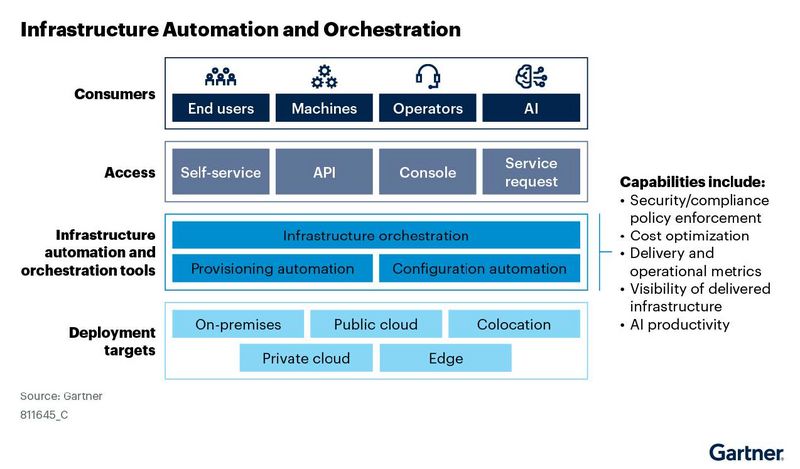
The illustration above highlights how the many components of an IA&O tool come together to help enhance:
- Security and compliance policy enforcement
- Cost optimization
- Delivery and operational metrics
- Visibility of delivered infrastructure
- AI productivity
Maximize Your Infrastructure Automation and Orchestration Investment
Over the years, automation has been added wherever it solved an immediate need. The result is often a collection of disconnected tools, scripts, and workflows. Bringing those investments together through IA&O simplifies operations, improves visibility, and creates a stronger foundation for platform engineering and AI.
Here are four ways to get more value from your IA&O investment:
Use IA&O to Enable Infrastructure Platform Engineering
According to Gartner, IPE initiatives increasingly depend on infrastructure orchestration to provide standardized infrastructure products while embedding governance, security, and compliance into every deployment.
Rather than building one-off scripts, organizations can create reusable workflows that support self-service infrastructure delivery, improve consistency, and reduce developer cognitive load.
Organizations that get the greatest return from automation aren’t simply writing more scripts. They’re building automation platforms that every team can leverage.
Extend IA&O to Support AI Initiatives
Artificial intelligence is changing infrastructure automation and orchestration in two significant ways.
- AI is making it easier to build automation. Gartner highlights capabilities such as natural language workflow development, productivity assistants, intent-based automation, and agentic AI as key innovations transforming how automation is developed.
- AI workloads themselves require sophisticated automation. As enterprises move AI initiatives from experimentation into production, IA&O becomes critical to provision AI infrastructure, manage GPU resources, coordinate data pipelines, orchestrate AI services, and support model lifecycles across hybrid environments.
Organizations that incorporate AI into their broader orchestration strategy will be better positioned to scale innovation while maintaining governance and operational control.
Embed Governance Into IA&O
Automation without governance simply allows organizations to make mistakes faster. That’s why governance has become a defining characteristic of modern infrastructure automation and orchestration.
Today’s organizations need workflows that automatically enforce:
- Security policies
- Compliance requirements
- Configuration standards
- Cost optimization
- Operational resilience
- Separation of duties
Gartner notes that policy enforcement is expanding beyond traditional security controls to include deployment governance, financial management, and configuration compliance. AI is also beginning to assist with policy creation and enforcement, helping organizations improve both speed and consistency.
The most effective automation platforms build governance into every workflow from the beginning.
Orchestrate Existing Automation Instead of Replacing It
Many enterprises already have robust provisioning, configuration management, cloud, and infrastructure automation tools. The challenge is getting them to work together.
Rather than creating another layer of disconnected automation, IA&O connects existing investments into standardized workflows that span infrastructure, cloud platforms, applications, and business processes. This orchestration layer helps organizations maximize previous investments while reducing operational fragmentation.
Instead of asking every tool to do everything, organizations can let each platform do what it does best while orchestration coordinates the entire workflow. That approach improves agility without requiring another large-scale technology replacement initiative.
How Stonebranch Helps Modernize Infrastructure Automation and Orchestration
Infrastructure automation becomes significantly more valuable when it extends beyond infrastructure tasks and orchestrates complete business services.
Stonebranch Universal Automation Center (UAC) helps organizations unify IA&O across hybrid IT environments through a single enterprise platform. Rather than replacing Terraform, Ansible, Kubernetes, cloud-native services, or existing schedulers, Stonebranch customers typically position UAC as the orchestration layer that coordinates these tools and the departments that use them. I&O teams continue using their preferred automation platforms while gaining centralized visibility, governance, dependency management, and event-driven execution across hybrid IT.
With Stonebranch, organizations can:
- Orchestrate infrastructure automation across on-prem, cloud, containers, and hybrid environments.
- Coordinate infrastructure, applications, ERP systems, and service workflows from one centralized platform.
- Automate hybrid cloud operations using event-driven workflows.
- Enable platform engineering through reusable, self-service automation.
- Orchestrate data pipelines and managed file transfers alongside infrastructure processes.
- Integrate with hundreds of enterprise platforms using the Universal Integration Platform and Integration Hub.
- Embed AI-powered tasks directly into production workflows using Robi AI while maintaining governance, security, and human oversight.
Rather than replacing existing automation investments, Stonebranch helps organizations connect them into a unified infrastructure automation and orchestration strategy.
This approach aligns with Stonebranch’s vision of intelligent orchestration that brings together automation, AI, and human decision-making to help organizations modernize hybrid IT, operationalize AI, and accelerate platform engineering initiatives.
Conclusion
Infrastructure automation and orchestration has evolved beyond automating individual infrastructure tasks. Today, it’s the foundation for platform engineering, hybrid IT operations, AI adoption, governance, and operational resilience. Organizations that realize the greatest value will orchestrate infrastructure, applications, cloud services, data pipelines, AI workloads, and business processes into connected, intelligent workflows.
Frequently Asked Questions
What is infrastructure automation and orchestration?
Infrastructure automation and orchestration (IA&O) is the practice of automating infrastructure tasks while coordinating them into end-to-end workflows across on-prem systems, cloud platforms, containers, applications, and business services.
Why is infrastructure automation and orchestration important?
Infrastructure automation and orchestration helps organizations reduce manual work, standardize infrastructure delivery, improve governance, support platform engineering initiatives, and manage increasingly complex hybrid and AI-enabled environments.
What is the difference between infrastructure automation and infrastructure orchestration?
Infrastructure automation focuses on automating individual tasks such as provisioning, configuration management, or deployment. Infrastructure orchestration coordinates multiple automated tasks into complete workflows that span infrastructure, applications, cloud platforms, and business processes.
What capabilities should an infrastructure automation and orchestration platform include?
A modern IA&O platform should provide provisioning automation, configuration automation, infrastructure orchestration, policy enforcement, hybrid cloud support, infrastructure-as-code (IaC), reusable workflow templates, integrations, monitoring, and governance capabilities.
How does AI improve infrastructure automation and orchestration?
AI improves infrastructure automation and orchestration by enabling natural language workflow creation, intelligent recommendations, intent-based automation development, agentic AI capabilities, and automation of AI infrastructure deployment and lifecycle management.
Author

Katie Paulin
Senior Content Marketing Manager
Katie Paulin is a creative marketer who publishes content to help the Stonebranch community get the most of their digital transformation initiatives. Before joining Stonebranch, Katie worked with global B2B tech leaders like Dematic and Johnson Controls. She holds a BS in Journalism & Mass Communications from the University of Wisconsin-Madison.