How an AI Gateway Works with a Hybrid Orchestration Control Plane
AI gateways govern which models your apps and agents can reach. A hybrid orchestration control plane governs everything that happens next.
An AI Gateway and a Hybrid Orchestration Control Plane address two different control problems inside an Enterprise Hybrid AI Architecture. The AI Gateway governs how applications, workflows, and agents access AI models. The Hybrid Orchestration Control Plane coordinates the end-to-end processes in which those model interactions occur.
The distinction becomes important when AI moves into production. A model may classify a document, diagnose a failure, recommend an action, or make a decision. The surrounding process still has to gather the right context, manage dependencies, apply approvals, handle exceptions, and carry the result into enterprise systems.
These two layers are easier to evaluate when their responsibilities are explicit. The sections that follow place them within the enterprise hybrid AI architecture and trace how a production workflow moves across both. That gives enterprise architects and IT leaders a practical basis for deciding which layer should control each part of the process.
Key Takeaways
- An AI Gateway provides a governed, consistent path to models and AI services.
- A Hybrid Orchestration Control Plane coordinates the workflows in which those AI interactions occur.
- The two capabilities work together and address different types of control.
- Separating model access from process orchestration makes it easier to change models, gateways, and agent technologies without rebuilding critical workflows.
What Is an AI Gateway?
An AI gateway sits between applications, workflows, or agents and the models they use. Instead of building a separate connection to every model provider, teams can route requests through a common layer.
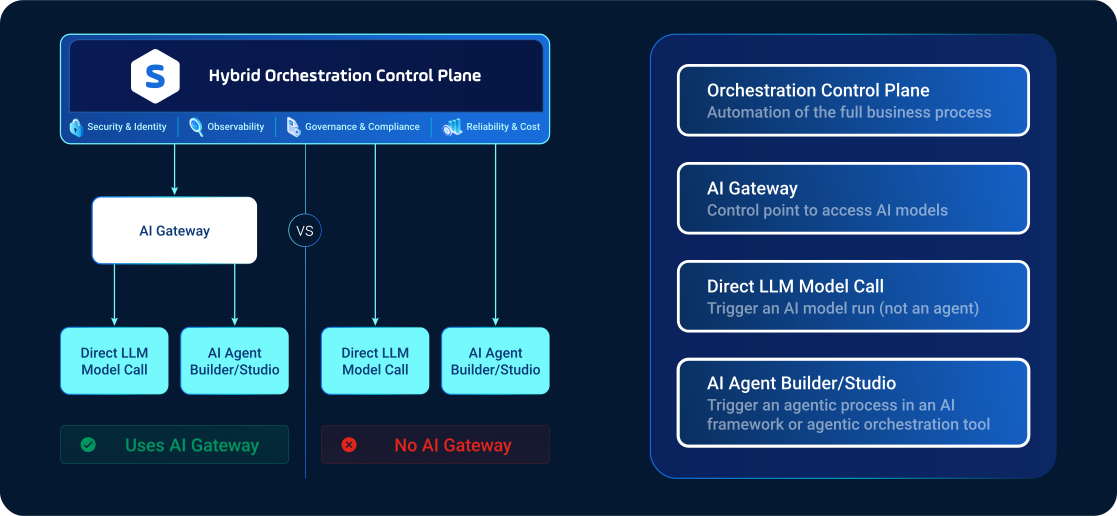
That layer can authenticate requests, enforce provider and model policies, manage quotas, route traffic, support failover, and track consumption. It also reduces the need to distribute provider credentials across applications and scripts. The exact feature set varies by product, but the primary responsibility is consistent: govern interactions with AI services.
As adoption grows, a shared access layer prevents each team from building its own provider integrations and routing logic. It also gives the organization a consistent view of model use across applications. That makes an AI gateway a practical foundation for a multi-model environment.
Where an AI Gateway Fits in the Enterprise Hybrid AI Architecture
The Enterprise Hybrid AI Architecture organizes the technologies required to move AI from a user request to action in the business. It includes five functional layers: interaction and request initiation; the Hybrid Orchestration Control Plane; AI and agent governance services; AI, agent, and deterministic execution; and the enterprise systems where work is performed. Security, observability, audit, and policy controls apply across the architecture.
An AI Gateway belongs primarily within the AI and agent governance services layer. It provides a controlled path to models and AI services, but it does not own the full business or IT process. The Hybrid Orchestration Control Plane sits above that layer and coordinates how work moves across the architecture.
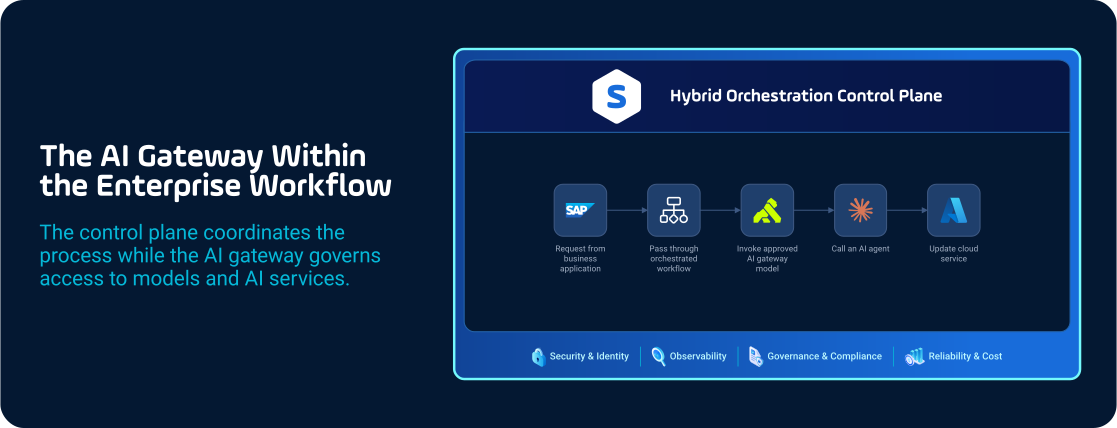
For example, a request may begin in a business application, pass through an orchestrated workflow, invoke an approved model through the AI Gateway, call an agent or deterministic automation, and then update an ERP system or cloud service. From the enterprise's perspective, that is one process. The architecture separates the responsibilities so each technology can perform its role without becoming the system of record for the entire process.
What Is a Hybrid Orchestration Control Plane?
A Hybrid Orchestration Control Plane is the execution and coordination layer for end-to-end business and IT processes. It manages workflows that combine deterministic automation with AI models and agents across on-premises, cloud, SaaS, container, and mainframe environments.
Its purpose is to preserve process continuity across technologies that operate differently. Deterministic tasks follow defined instructions and produce predictable results. AI models and agents introduce probabilistic decisions and more dynamic execution. The Hybrid Orchestration Control Plane coordinates both within the same process while maintaining workflow state, dependencies, approvals, service-level requirements, exception handling, and recovery logic.
This process-level view is what connects the layers of the Enterprise Hybrid AI Architecture. The control plane knows how the work started, which steps have completed, what is waiting, which policies apply, and what must happen next. It can pause for human review, reroute work when a service is unavailable, or trigger a recovery path when an action fails.
These responsibilities do not create rigid product boundaries. AI Gateway vendors may add workflow, observability, or agent features. Orchestration platforms may connect directly to models or expose approved workflows as tools for agents. The architectural distinction is based on accountability: the AI Gateway governs the AI interaction, while the Hybrid Orchestration Control Plane remains accountable for execution of the end-to-end process.
| Layer | Primary Responsibility | Typical Controls |
|---|---|---|
| AI Gateway | Govern AI and model interactions |
|
| Hybrid Orchestration Control Plane | Coordinate end-to-end process execution |
|
How an AI Gateway and Hybrid Orchestration Control Plane Work Together
Consider a production workflow that fails in the middle of the night. The Hybrid Orchestration Control Plane can start a diagnostic workflow and collect the task output, execution history, dependency information, infrastructure status, and recent deployment data. It then sends the relevant context through the organization's approved AI Gateway.
The gateway authenticates the request, applies the organization's model policies, selects an approved provider, and records the consumption. A model or agent analyzes the information and returns a recommended action.
The Hybrid Orchestration Control Plane then continues the process. It can route a high-risk recommendation for approval, pause dependent jobs, run an approved remediation, and verify whether the affected service has recovered. If the remediation fails, the workflow follows the defined exception or escalation path.
The AI Gateway manages the model interaction, and the model or agent performs the assigned task. The Hybrid Orchestration Control Plane retains the execution context and moves the workflow to its next step.
Keeping the AI Stack Flexible
AI technology is changing quickly. Organizations will add models, replace providers, introduce new agents, and revise policies as their requirements change. Those changes should not force teams to redesign the business and IT processes that rely on AI.
Separating AI access from process orchestration helps preserve that flexibility. An AI Gateway can route a request to a different provider without changing the surrounding workflow. A new agent can take on a task while the Hybrid Orchestration Control Plane continues to manage its dependencies, approvals, and downstream actions. The process remains stable even as individual AI components change.
This approach also keeps AI connected to the enterprise automation strategy. Models and agents can participate in workflows that already span SAP, data platforms, infrastructure, file transfers, cloud services, and other systems. Teams do not need a separate operating model for every AI use case.
Stonebranch UAC as the Hybrid Orchestration Control Plane
Stonebranch Universal Automation Center is the Hybrid Orchestration Control Plane for end-to-end business and IT processes. UAC gives teams a central place to build, run, monitor, and manage workflows across hybrid environments. Those workflows can combine deterministic automation with AI models and agents, including models accessed through an organization's chosen AI Gateway.
UAC connects AI-driven work with the applications, data, infrastructure, and automation that already run the enterprise. It maintains process context from the initial event through the final outcome, including dependencies, approvals, exceptions, and recovery steps.
Within the Enterprise Hybrid AI Architecture, the AI Gateway governs access to AI services. Stonebranch UAC coordinates how those services contribute to the larger process. This division gives enterprises a stable orchestration layer while models, gateways, agent frameworks, and other AI technologies continue to change.
Ready to bring AI into your enterprise workflows? Explore how Stonebranch Universal Automation Center can orchestrate AI-powered work across your hybrid IT environment.
Frequently Asked Questions
What is the difference between an AI Gateway and a Hybrid Orchestration Control Plane
An AI Gateway governs access to models and AI services. A Hybrid Orchestration Control Plane coordinates the complete workflow around those interactions, including execution state, dependencies, approvals, exceptions, and recovery.
Where does an AI Gateway fit in an Enterprise Hybrid AI Architecture
An AI Gateway sits primarily in the AI and agent governance services layer. It applies controls to model interactions, while the Hybrid Orchestration Control Plane coordinates work across the architecture.
Do enterprises need both an AI Gateway and a Hybrid Orchestration Control Plane
They address different responsibilities. The AI Gateway provides consistent controls for AI requests. The Hybrid Orchestration Control Plane connects those requests to the wider business or IT process.
Can Stonebranch UAC work with an existing AI Gateway
Yes. UAC can call models or agents through an organization's approved AI Gateway and coordinate what happens before and after the AI interaction.
Author

Scott Davis
Chief Marketing Officer
Scott Davis is Chief Marketing Officer at Stonebranch, where he leads global brand, product marketing, demand generation, and corporate communications. He brings 20+ years of B2B SaaS marketing experience, with prior senior leadership roles at SAP and Calero Software.