AI Workflow Automation Governance: Why Enterprises Need Execution Controls, Not Just Guardrails
AI agents now restart services, update SAP, and trigger financial processes. Governing what they do requires execution governance.
Key Takeaways
- AI workflow automation governance extends model-level controls to encompass the execution of AI-initiated enterprise processes.
- Separating decision authority (what the agent decides) from execution authority (how that decision is carried out) is the architectural foundation of governed agentic automation.
- Limiting an agent’s “blast radius” — the scope of systems it can affect — is a core safety principle.
- Governed workflows expose approved processes as agent-invokable capabilities, without giving agents direct access to credentials or production systems.
- Six controls define effective governance: access, policy, approval, execution, recovery, and evidence.
- SOAPs are the infrastructure layer where these controls are enforced at enterprise scale.
What Is AI Workflow Automation Governance?
AI workflow automation governance is the set of policies, controls, and enforcement mechanisms that determine what AI agents are allowed to execute — not just what they are allowed to access or recommend. It is the operational complement to traditional AI governance, which focuses on model behavior, data access, and prompt integrity.
This distinction is important because the risks are different. Governance that tells an agent how it should behave is not the same as governance that enforces how it is allowed to behave. The first is a prompt instruction. The second is a control embedded in infrastructure. A useful way to frame the two layers:
| Governance Layer | What It Controls |
|---|---|
| AI governance | What AI can access, reason about, and request |
| Execution governance | What AI can actually execute, against which systems, under which conditions |
These layers are complementary. An AI gateway governs which models an agent can reach. An agent governance system governs which tools it can call. A service orchestration and automation platform (SOAP), or the enterprise orchestration layer, governs the execution of the enterprise process that begins when the agent invokes one of those tools. Each layer solves a different part of the problem. According to the 2026 Gartner Magic Quadrant for Service Orchestration and Automation Platforms, by 2030, 50% of SOAP activity will be initiated by AI agents — up from less than 5% today. That trajectory makes execution governance a strategic priority now, not a future consideration.
Separate Decision Authority from Execution Authority
One of the most important architectural principles for enterprise AI workflow automation governance is this: decision authority and execution authority do not have to reside in the same system.
An AI agent can determine which approved action is needed without unrestricted access to the systems that perform the work.
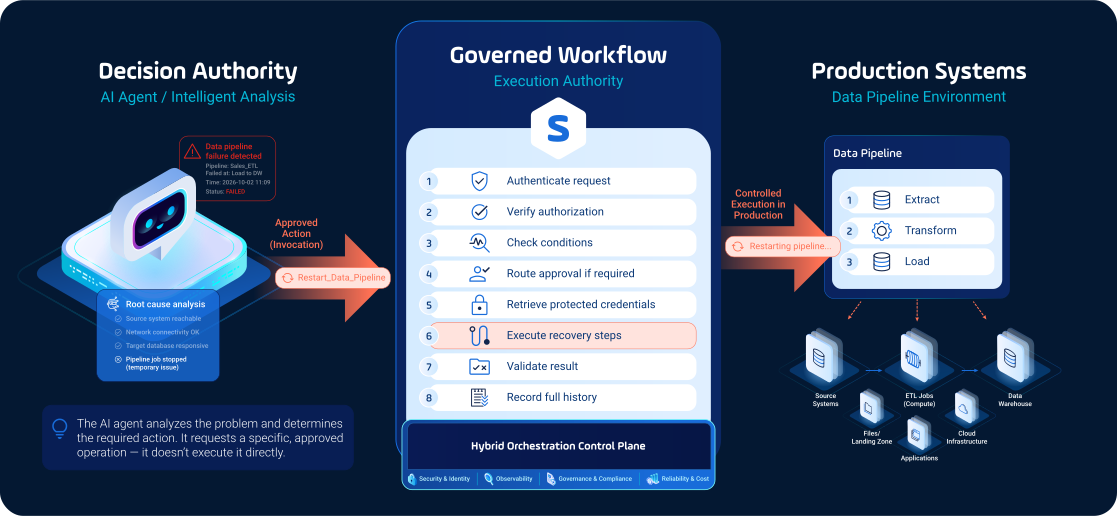
As an example, let’s explore a data pipeline failure in which an agent is used to analyze the problem. The agent diagnoses the root cause and invokes an approved capability:
- Restart_Data_Pipeline
Behind that capability is a governed workflow. It authenticates the request, verifies authorization, checks conditions, routes approval if required, retrieves protected credentials securely, executes the recovery steps, validates the result, and records the full execution history. The agent contributes the intelligence. The orchestration layer contributes the control. Neither has to do the other’s job.
This separation is what makes it possible to give AI agents meaningful enterprise authority without simultaneously granting unrestricted access to production systems. It is the architectural foundation of governed agentic automation.
Limiting the Blast Radius of AI Agent Actions
In DevOps and incident management, blast radius refers to the scope of potential damage when something goes wrong. The same concept applies directly to AI agents. Every action an agent can initiate has a potential blast radius: the systems it can affect, the data it can modify, the processes it can interrupt, and the business impact if the action is wrong.
The core principle is straightforward: the more tightly you scope what an agent is permitted to affect, the safer it becomes to extend what it is permitted to do. An agent with narrow, well-defined authority fails small. An agent with broad, loosely defined authority can fail broadly.
Blast radius is not a reason to avoid giving agents operational authority. It is a reason to structure that authority deliberately. The six governance controls below provide the implementation framework.
Six Controls Behind AI Workflow Automation Governance
Effective AI workflow automation governance is implemented through six operational controls. Together, they define what an agent is allowed to execute, how that execution occurs, and what happens when things go wrong.
- Access: What Can the Agent Invoke?
Access controls determine which agent identities can invoke which workflows in which environments. A customer service agent may be authorized to initiate a refund process but not a cloud infrastructure change. This scoped access model limits blast radius at the policy level — the agent receives a defined set of approved capabilities appropriate to its role, not a universal toolbox. - Policy: Under What Conditions Can It Act?
Authorization is not unconditional permission. Policies determine whether a given action is allowed at a specific moment, against a specific resource, in a specific environment. The governance question shifts from “Can this agent do this?” to “Can this agent do this, against this resource, in this environment, right now?” — and the orchestration platform enforces the answer. - Approval: When Does a Human Retain Authority?
Human approval is a calibration mechanism, not an obstacle. Organizations define different autonomy levels based on risk: an agent may auto-retry a failed development workflow, while the same agent must route a production database restart through a designated approver. In a governed workflow, approval is a formal human-in-the-loop step embedded in the execution path — the workflow pauses, routes to the approver, captures the authorization, and resumes only after approval is granted. - Execution: How Is the Work Performed?
The governed workflow defines the sequence of operations, dependencies between steps, which systems are called, which credentials are used, and what constitutes a valid output. Credentials remain inside the automation environment — the agent never sees them. The agent invokes the capability; the orchestration platform retrieves and applies the credentials and executes the approved procedure. - Recovery: What Happens When Things Go Wrong?
Enterprise processes fail in unpredictable ways, and an AI agent improvising its own recovery is itself a governance risk. Governed workflows define in advance how failures are handled: automated retries, compensation steps, alternate execution paths, rollback sequences, or escalation to human review. When something goes wrong, the organization responds according to a defined procedure, not according to whatever the agent decides to try next. - Evidence: Can You Reconstruct What Happened?
As AI agents become initiators of enterprise work, auditability becomes a compliance and operational requirement. Execution histories, audit logs, approval records, and workflow version tracking create an evidence trail that makes AI-driven automation observable in the same way enterprises already monitor human- and system-initiated work. For regulated industries, this is not optional.
AI Workflow Automation Governance in Practice
In each scenario below, the agent detects, decides, and invokes — the orchestrator verifies, controls, and records.
| Scenario | What the Agent Does | What the Orchestrator Does |
|---|---|---|
| IT Operations: Production Service Restart |
|
|
| Finance: Month-End Processing |
|
|
| Data Operations: Pipeline Recovery |
|
|
The Goal Is More AI Autonomy, Not Less
A common concern is that execution governance constrains what AI agents can accomplish. The opposite is true. Without governed workflows, organizations face a difficult choice: grant agents broad system access and accept the risk, or restrict them so narrowly they cannot do meaningful work. Neither is a viable enterprise operating model.
With governed workflows and a SOAP platform providing the execution layer, organizations can extend real operational authority to AI agents while maintaining precise control over how that authority is exercised. The blast radius of every action is bounded by the workflow definition. Failures are governed, not improvised. The evidence trail for every action is complete. And as governance matures, agent authority can expand — safely.
Don’t rely solely on AI to remember the rules. Build the rules into the way work gets executed.
How Stonebranch Supports AI Workflow Automation Governance
Stonebranch Universal Automation Center (UAC) provides the orchestration foundation enterprises need to implement workflow governance at scale. The UAC platform is a Hybrid Orchestration Control Plane designed to coordinate and manage the full spectrum of enterprise automation, including deterministic tasks, AI tasks, and AI agents.
As a Leader in the 2026 Gartner Magic Quadrant for SOAPs for the third consecutive year, UAC delivers the access controls, policy enforcement, approval workflows, credential management, error handling, and audit capabilities that transform AI-initiated actions into governed enterprise processes.
Frequently Asked Questions
What is AI workflow automation governance?
AI workflow automation governance is the set of policies, controls, and enforcement mechanisms that determine what AI agents are permitted to execute in enterprise environments — not just what they are allowed to access or recommend. It includes controls over which workflows agents can invoke, under what conditions, with what level of human oversight, and with what audit trail.
How is AI workflow automation governance different from traditional AI governance?
Traditional AI governance focuses on the model itself: which models employees can use, what data they can access, how prompts and outputs are managed, and how costs are monitored. AI workflow automation governance focuses on execution: what actions are actually permitted to occur, against which systems, under which conditions, and with what controls in place. The two layers are complementary, not interchangeable.
What is a governed workflow?
A governed workflow is a predefined, policy-enforced automation process that’s exposed to AI agents as an approved capability to invoke. Instead of giving agents direct access to credentials, infrastructure, and production systems, governed workflows abstract the execution details and enforce access, policy, approval, and logging requirements through the orchestration platform.
What is the blast radius of an AI agent?
The blast radius of an AI agent refers to the scope of potential operational, business, or compliance impact if the agent makes an error, receives incorrect input, or is exploited. Reducing blast radius involves scoping agent access to the minimum required for its role, defining pre-approved execution paths that the agent cannot deviate from, requiring human approval for high-impact actions, and enforcing rollback procedures for failures.
What role do SOAPs play in AI workflow automation governance?
Service orchestration and automation platforms (SOAPs) provide the infrastructure layer where AI workflow automation governance controls are implemented and enforced. RBAC, policy engines, approval workflows, secure credential management, dependency controls, error handling, and audit logging — the capabilities SOAPs have provided for traditional automation — become the execution governance layer for AI-initiated automation. Gartner projects that by 2030, 50% of SOAP activity will be initiated by AI agents.
Should every AI agent action require human approval?
No. The appropriate level of human oversight depends on the risk, reversibility, and business impact of each action. Low-risk, well-understood operations can execute automatically. Actions with significant operational or compliance consequences — production database changes, high-value financial transactions, bulk infrastructure modifications — should route through a human approval step. The governed workflow enforces this calibration; the AI agent simply invokes the approved capability.
How does this approach enable more AI autonomy, not less?
Governance frameworks built around governed workflows and SOAP platforms make it safe to expand AI authority over time. When the blast radius of each capability is bounded, when failures are governed rather than improvised, and when every action produces a complete audit trail, organizations can confidently extend AI agents’ operational scope. The goal isn’t limiting what agents can accomplish — it’s building the operational trust that makes expanding their authority possible.