Governed Workflows: How to Make AI Agent Execution Safe and Reliable
Governed workflows are how enterprises give AI agents real authority without losing control.
AI agents can operate software, provision infrastructure, and trigger business processes without a human in the loop. Enterprises are actively expanding agent authority to extract more value from AI automation. As a result, they’re running directly into the question of what that “authority” should cover. Governed workflows answer the question.
Giving an agent unrestricted access to mission-critical systems is a risk most enterprise organizations won’t accept. But pulling agents back from those systems undercuts the entire point of AI.
The problem isn’t the agent’s ability to decide. Modern AI agents can determine which action to take. The problem is execution: what controls how that action runs when the underlying system is production infrastructure or a live business process.
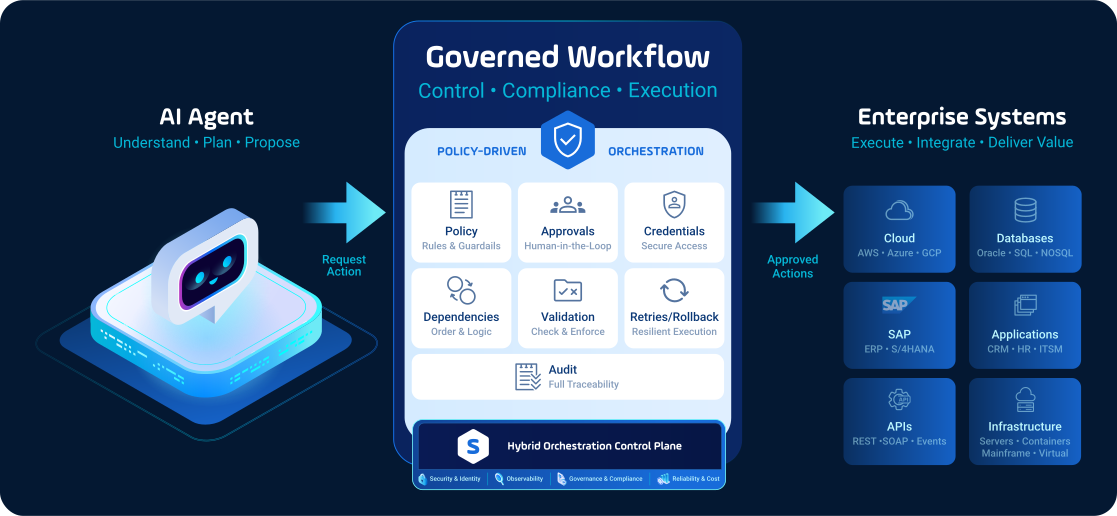
Governed workflows provide that control. The agent makes the decision; the governed workflow handles the execution. Rather than directly touching an enterprise system, the agent makes a tool call to an approved workflow that runs on defined logic and within defined parameters.
The agent decides what to do. The workflow controls how it gets done.
That separation between agentic decision-making and deterministic enterprise automation is the design principle central to this article. It’s also the reason governed workflows are emerging as the standard for deploying AI agents at enterprise scale.
What is a Governed Workflow?
A governed workflow is an approved enterprise process that an AI agent can invoke as a tool call. The agent chooses the capability it needs; the workflow controls how the action executes — enforcing authorization, sequencing steps, protecting credentials, managing dependencies and approvals, validating results, and handling retries, rollback, and audit.
Because AI agents are probabilistic, they can interpret context and determine what should happen next, but their outputs are not always the same. Governed workflows provide the deterministic execution layer, following defined logic to carry out that decision consistently.
Instead of giving an agent direct access to the systems behind a process, the organization exposes a specific workflow as an approved capability.
Why AI Agents Need Governed Workflows
During the past year, the frontier AI model market has disclosed numerous reasons for enterprises to be wary of agents. But that doesn’t mean that agents can’t be controlled. It just means that they weren’t controlled in those instances.
Agents are given an objective via a prompt. When unbounded, they have access to powerful tools. And agents are designed to determine how to solve their objective and then accomplish it. As such, we shouldn’t be all that surprised that agents are doing their job. These are not rogue agents with malicious intent. Rather, agents are just really good at finding ways to execute in ways that the people deploying them never intended.
Governed workflows are used to prevent unintended execution patterns.
In contrast, a prompt can guardrail an agent’s behavior, but it cannot enforce permissions in the systems that perform the work. Monitoring can show what happened after execution begins, but high-impact actions also require preventive controls that limit which capabilities are available and how they run.
Governed workflows place those controls outside the AI model. They give the agent access to an approved business or IT capability while protecting the systems, credentials, and process logic behind it.
Three Approaches to Controlling Agent Behavior
Not all controls are equal. Prompt-based guardrails and direct system access are common starting points, but neither provides the enforcement that enterprise systems require.
| Capability | Direct System Access | Prompt-Based Guardrails | Governed Workflows |
|---|---|---|---|
| Where controls are enforced | In the system, if at all | Inside the AI model | Outside the AI model |
| Agent exposure to credentials | Full access | Full access | None |
| Execution consistency | No | No | Yes |
| Audit trail | Varies by system | No | Yes |
| Rollback and error recovery | Varies by system | No | Yes |
| Approval workflow support | No | No | Yes |
| Suitable for mission-critical processes | High risk | High risk | Yes |
Industry Analysts Are Converging on the Same Architecture
Forrester’s June 2026 Agentic Runtime Architecture lays out the pattern directly: expose enterprise capabilities as governed tools and intercept tool calls before execution to enforce security, compliance, risk, and cost policies. An August 2026 Forrester blog frames the alternative plainly as agent sprawl.
McKinsey reaches the same conclusion from a different angle. Its guidance on building foundations for agentic AI at scale calls for a shared execution layer that routes agent-invoked tools and APIs through governed interfaces rather than around existing controls.
Gartner names the underlying tension: what an agent can do technically and what access it should have are different questions. Its 2026 research ties control requirements, including approval workflows, enforced guardrails, rollback mechanisms, monitoring, and circuit breakers, directly to the level of autonomy involved. It predicts 40% of enterprises will demote or decommission autonomous agents by 2027 after governance gaps surface in production.
ISACA’s September 2026 guidance adds a security framing: separate reasoning from execution, place agent-accessible tools behind a policy-enforcement layer, and treat tool misuse and excessive agency as primary risks rather than secondary ones.
Different terminology. Same architectural direction.
How Governed Workflows Control the Execution Path
Most enterprises already have deterministic automation workflows for critical processes. Backend machine-to-machine workflows are typically run within an enterprise-grade service orchestration and automation platform (SOAP). Gartner coined the term SOAP in 2020 to replace legacy categories such as workload automation and job scheduling.
These SOAP-powered workflows coordinate applications, databases, infrastructure, mainframes, containers, data pipelines, and even managed file transfers. They also contain operational knowledge about sequencing, dependencies, validation, recovery, and audit requirements.
Two Common Governed Workflow Patterns:
- Governed Workflow as an Agent Tool Call
- Agent-as-a-Step Inside a Governed Workflow
Let’s go ahead and explore how each pattern works.
1. Governed Workflow as an Agent Tool Call
In the agentic era, SOAPs are used to combine and coordinate agentic (probabilistic) alongside traditional (deterministic) automation. Instead of giving an AI agent direct access to the systems behind a process, organizations can expose an approved workflow via a SOAP as a scoped tool.
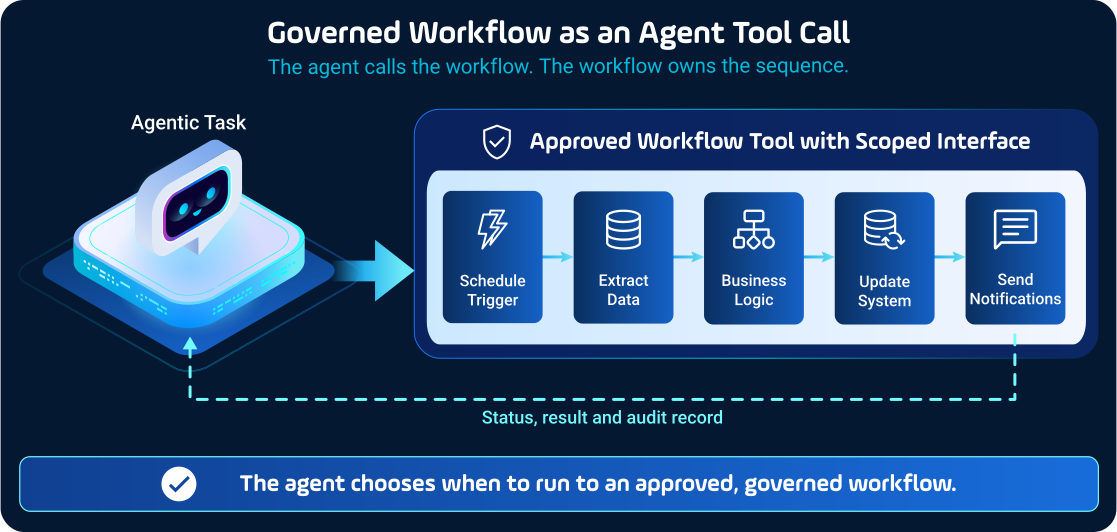
For example, an agent can:
- Trigger an approved production change workflow instead of connecting directly to a database.
- Provision cloud infrastructure via a workflow without receiving broad cloud administration access.
- Start an application recovery workflow instead of issuing raw infrastructure commands.
The agent decides which capability to use and when. The governed workflow provides the execution sequence.
2. AI-Enhanced Workflows add Agents as Steps Inside Governed Workflows
An AI agent doesn’t always need to initiate the process. In many cases, the workflow should remain in control and call the agent when a task requires interpretation, classification, or reasoning.
Consider an incident-response workflow. Deterministic automation can collect diagnostic data, check dependencies, and gather recent workload history. At a defined point in the process,
- The workflow can ask an AI agent to summarize the evidence or recommend an approved response.
- The workflow then receives the result back from the agent and continues with the appropriate validation, approval, or recovery steps.
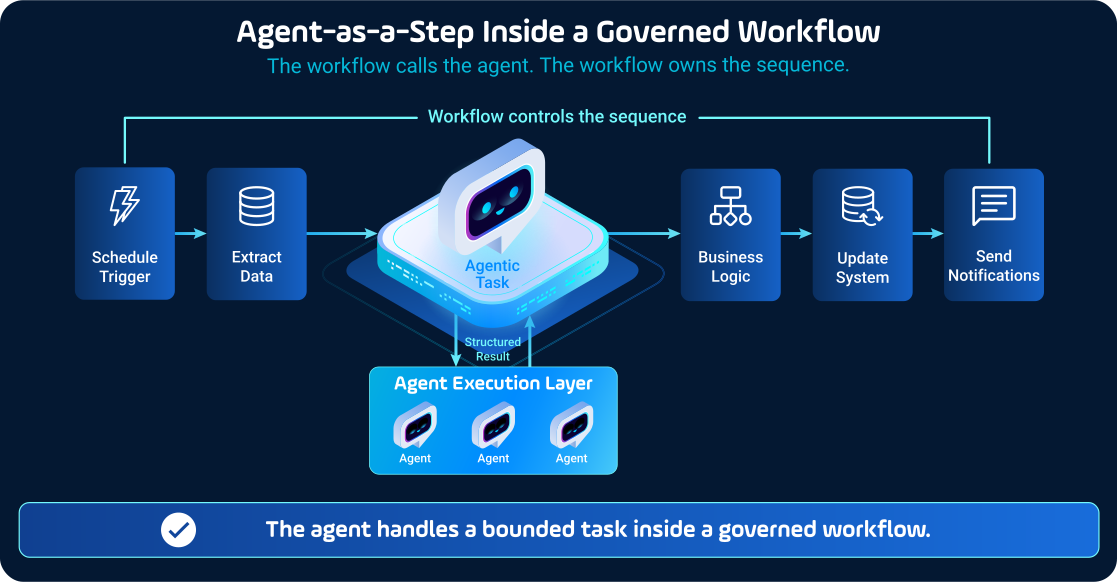
The agent-as-a-step inside a governed workflow pattern is useful when most of the process is already known, but one step benefits from probabilistic reasoning. The workflow defines the context supplied to the agent, the bounded task it may perform, and the type of result it must return. It then validates that result before using it elsewhere in the process.
When a workflow reaches an AI step, the agent might classify an incident, summarize operational evidence, interpret unstructured information, or recommend one of several approved actions. Other examples of using an agent within a workflow can be found here.
The agent handles tasks that require flexibility and judgment. The governed workflow continues to control the sequence, connected systems, approvals, monitoring, and recovery logic. An additional benefit is that this pattern lets you add AI where it provides value without rebuilding established deterministic processes.
Coordinate Agentic and Deterministic Work with UAC
Stonebranch Universal Automation Center (UAC) provides a SOAP-powered Hybrid Orchestration Control Plane that coordinates deterministic workflows and probabilistic AI tasks across cloud, on-premises, and hybrid environments.
UAC supports both governed workflow patterns:
- Governed Workflow as an Agent Tool Call: Expose existing workflows as approved tools that AI agents discover and invoke.
- Agent-as-a-Step Inside a Governed Workflow: Incorporate probabilistic AI tasks directly into deterministic workflows
Bring AI Decisions into Governed Execution
AI agents create value when their decisions lead to action. But enterprise action still requires defined execution paths and operational safeguards. Governed workflows provide that structure, whether an agent invokes an approved workflow or a workflow calls an agent for a bounded task.
With UAC coordinating both patterns, organizations can add AI to existing automation without replacing the reliable processes they already depend on. Teams gain the flexibility of agentic automation while maintaining centralized visibility, governance, and control across hybrid IT.
See how UAC supports governed workflows for agentic execution.
Author

Katie Paulin
Senior Content Marketing Manager
Katie Paulin is a creative marketer who publishes content to help the Stonebranch community get the most of their digital transformation initiatives. Before joining Stonebranch, Katie worked with global B2B tech leaders like Dematic and Johnson Controls. She holds a BS in Journalism & Mass Communications from the University of Wisconsin-Madison.