Twice the Power: Complete Container Orchestration Starts with UAC’s Dual Approach
Orchestrate your hybrid IT environment with UAC in containers. Deploy in minutes, automate across platforms, and embed intelligence into every pod, service, and system.
Enterprises are doubling down on containers to modernize infrastructure and scale services fast. But agility introduces complexity — especially when you need to automate consistently across dynamic containerized environments. That’s why Stonebranch enables two distinct, complementary approaches: you can deploy the Universal Automation Center (UAC) in containers, and you can use UAC to automate workloads inside containers.
Here’s how these approaches work — and why both are critical to orchestrating automation across hybrid IT environments.
Containers: What are They and Why is Automation Important?
Container technologies, such as Kubernetes, and container management platforms, like OpenShift, have revolutionized how enterprises deploy, scale, and manage applications. By packaging applications with all their dependencies, containers ensure consistency across environments. But while containers bring speed and flexibility, they also introduce new automation challenges.
Every containerized workload should be automated to avoid fragmentation, silos, and manual inconsistencies. The goal is to centrally automate containers alongside the rest of your hybrid IT environment. Today, it's possible to do this from a single automation platform that has the capability to perform container orchestration.
With Stonebranch UAC, you can both deploy the automation platform inside a container and automate any process running inside other containers.
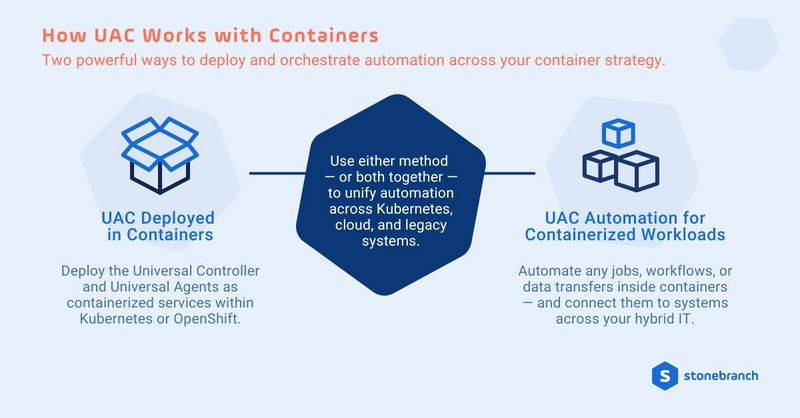
How UAC Works with Containers
Stonebranch supports container automation in two distinct ways:
- UAC deployed in containers: This is where the Universal Controller or Universal Agents themselves run as containerized workloads, typically inside Kubernetes or OpenShift. It’s a fast and scalable way to deploy the platform that supports both departmental and enterprise-wide use cases.
- UAC automates workloads inside containers: UAC orchestrates any jobs, workflows, or data transfers that run inside containerized applications. This includes coordinating across pods, services, and clusters, as well as connecting containerized workloads with the rest of your hybrid IT ecosystem.
These methods combine to unify automation across modern infrastructure — delivering orchestration that scales with your environment and business.
Deploy Universal Controller in Containers for Fast, Scalable Automation Anywhere
Deploying UAC’s brains — Universal Controller (UC) — inside containers unlocks faster time-to-value and broader automation access across teams. UC can be containerized and deployed via Helm into Kubernetes or OpenShift environments, enabling organizations to launch production-ready orchestration capabilities in minutes. This approach eliminates the need for manual provisioning or traditional installations, and allows UAC to scale alongside your infrastructure. It’s ideal for teams modernizing infrastructure, testing new deployments, or enabling automation as a service across the enterprise.
Benefit: Self-Service Deployment by Developers
Developers can deploy UC in Kubernetes or OpenShift environments using a single Helm command. This enables the launch of orchestration environments on demand, eliminating the need to wait for IT infrastructure teams. With everything defined in YAML — from services to credentials — deployment becomes repeatable, version-controlled, and integrated into CI/CD pipelines. It’s automation infrastructure-as-code, built for DevOps speed.
Benefit: Deploy UAC for Departments
Stonebranch makes it easy to deploy isolated UC instances for different departments, business units, or regional teams — all within the same Kubernetes cluster. This modular approach supports autonomy without sacrificing oversight. Central IT retains governance while other teams get the flexibility to build, test, and run workflows independently.
Benefit: Speed and Ease of Deploying UAC
In traditional environments, deploying a workload automation platform could take hours — or longer. With containerized UAC, the entire environment (UC, OMS middleware, and SQL database) can be deployed and connected in under two minutes. Logs are immediately visible inside Kubernetes, agents can be registered in seconds, and automation is ready to run. This dramatically accelerates time-to-value and simplifies ongoing operations.
Watch the demo: See how UAC can be deployed inside OpenShift in real time — from Helm command to fully orchestrated automation in under two minutes.
Run Universal Agent in Containers to Automate Everything Inside — and Beyond
When Universal Agents (UAs) are containerized, you embed automation directly into your workloads. These agents live inside the same pods as your applications or microservices, which allows your automation to follow the workload wherever it goes — from staging to production, or across clusters. The agent automatically inherits lifecycle awareness, scaling up or down with the application and enabling real-time orchestration. This design enables you to execute tasks directly within the container, while maintaining visibility, governance, and control through UAC’s centralized interface.
Benefit: Automate What’s in a Container
When UA runs directly inside the container alongside your application or service, UAC can execute automation tasks from within the same runtime context — whether that’s a job script, API call, data transformation, or even infrastructure operation. By embedding automation at the workload level, organizations gain native execution, improved reliability, and workload-aware orchestration that scales automatically with the container.
Benefit: Connect Automation in a Container to Automation Outside
Workloads inside containers rarely operate in isolation. With UAC, containerized agents can trigger, or be triggered by, external systems like mainframes, SaaS platforms, cloud services, or on-prem servers. This bi-directional integration creates a cohesive automation fabric across your hybrid IT environment. It breaks down silos and enables business processes to span multiple systems seamlessly.
Benefit: Move Data into a Container from Anywhere (Mainframe Included)
Containers often require external data for processing, analytics, or API calls. UAC includes built-in managed file transfer (MFT) capabilities that let you securely move data from any source — including mainframes, databases, or cloud storage — into the container environment. You can even transfer data between different Kubernetes clusters and namespaces.
Workflows can be triggered by file events or orchestrated as part of a larger workflow, ensuring secure, policy-driven, and fully auditable transfers.
Platform-Specific Integration and Observability
UAC supports all major Kubernetes platforms:
- Red Hat OpenShift: UAC supports job templates that allow users to predefine recurring workloads with parameters, enabling efficient reuse and simplified governance of job configurations.
- Google Kubernetes Engine (GKE): UAC integrates via Service Account Key authentication and supports runtime impersonation of other service accounts — making it easier to manage access and execution rights securely within GKE clusters.
- Azure Kubernetes Service (AKS) and AWS Elastic Kubernetes Service (EKS): UAC offers native authentication and real-time log streaming, allowing users to observe job execution and resource behavior directly within the UAC interface.
- SAP Kyma on SAP BTP: Through the SAP Kyma integration, UAC extends workload automation to containerized applications on SAP BTP, enabling consistent execution and monitoring across hybrid cloud environments.
UAC also captures pod status, execution logs, and real-time observability data — all within its centralized interface. That means full SLA tracking, audit control, and compliance-ready monitoring across all containerized workloads.
Observability
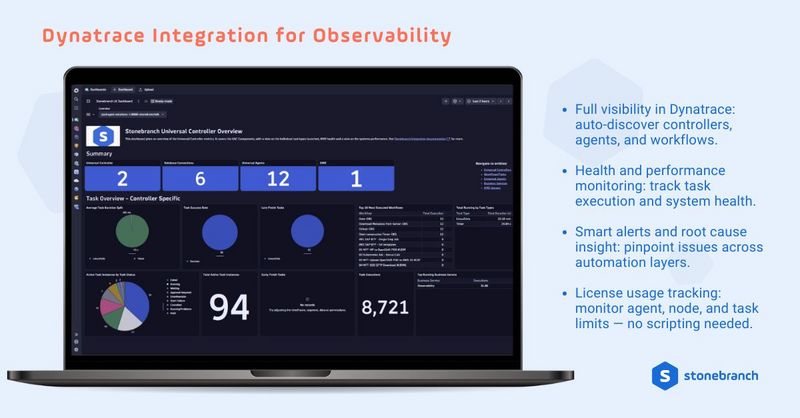
UAC offers full-stack observability across your entire hybrid IT environment — including deep visibility into containerized workloads. With native support for OpenTelemetry standards and Prometheus monitoring, UAC captures traces, metrics, and logs to help teams oversee workload execution, performance, and resource utilization in real-time.
To simplify adoption, UAC includes prebuilt dashboards for popular platforms like Grafana, Dynatrace, and Datadog. For Dynatrace users, a certified UAC extension delivers reliable visualization without added complexity.
The Strategic Value of UAC in Containers
By deploying and orchestrating automation within containers, Stonebranch helps organizations build a bridge between cloud-native innovation and enterprise-scale orchestration. Whether you’re modernizing mainframes, scaling container workloads, or synchronizing global operations, UAC ensures automation is connected, centralized, and built to move at the speed of business.
With Stonebranch, containers don’t just run — they run with purpose.
Frequently Asked Questions:
What is Stonebranch UAC in a container?
Stonebranch Universal Automation Center (UAC) in a container refers to deploying the Universal Controller or Universal Agent as containerized services within platforms like Kubernetes or OpenShift. This enables fast, scalable orchestration of IT automation across hybrid environments.
Can Stonebranch UAC automate workloads inside Kubernetes containers?
Yes. Stonebranch UAC can automate any workload inside a Kubernetes container — including batch jobs, microservices, and APIs. It embeds automation directly into the pod and connects container-native workflows with cloud, mainframe, and on-prem systems.
What are the benefits of deploying UAC inside containers?
Deploying UAC inside containers offers faster setup, self-service deployment for developers, and the ability to scale across departments. It also simplifies automation across hybrid IT by integrating directly with platforms like OpenShift, GKE, AKS, and EKS.
How does UAC connect containerized automation with legacy systems?
UAC connects containerized automation to legacy systems like mainframes or on-prem databases using built-in agents and managed file transfer (MFT) capabilities. This enables hybrid workflows that span modern containers and traditional IT infrastructure.
What platforms support UAC container deployments?
Stonebranch UAC supports container deployments on Red Hat OpenShift, Google Kubernetes Engine (GKE), Azure Kubernetes Service (AKS), and AWS Elastic Kubernetes Service (EKS), offering native authentication, job templates, and log streaming.
How fast can I deploy Stonebranch UAC in Kubernetes?
You can deploy Stonebranch UAC in Kubernetes in under two minutes using Helm. The setup includes the Universal Controller, database, and OMS middleware, allowing you to begin orchestrating automation almost immediately.
Start Your Automation Initiative Now
Schedule a Live Demo with a Stonebranch Solution Expert