


Product information "UAC Utility: Enhanced Linux"
Since the release of UC8.1 the functionality of this integration is included in the standard linux/windows [delete as applicable] task.
Linux and Unix systems are commonly automated through shell commands and shell scripts executed on the target host, frequently under a dedicated service account and with a login profile that establishes the environment the workload expects.
This Universal Task allows customers to run shell commands and shell scripts on a Linux host straight from the Universal Controller, with control over the executing user, the environment profile applied before execution, and where the produced output is stored.
Key Features
- Run either an inline shell command or a full shell script on the target Linux host and return its exit code to the Universal Controller
- Run the command or script as a different local user through sudo, without requiring the Universal Agent to run as that user
- Source a profile file before the command or script runs, so the workload executes with the environment it expects
- Redirect STDOUT and STDERR to files on the target host, in either overwrite or append mode, while still returning the content to the Task Instance
| Extension Name: | ue-enhanced-linux |
|---|---|
| Universal Template Name: | Enhanced Linux |
| Version: | 1.0.0 |
| Compatibility : | UC/UA 7.6 and above |
| Support: | Stonebranch Certified |
Use Case 1: Collect a Linux Host Report and Email it to Stakeholders
Description
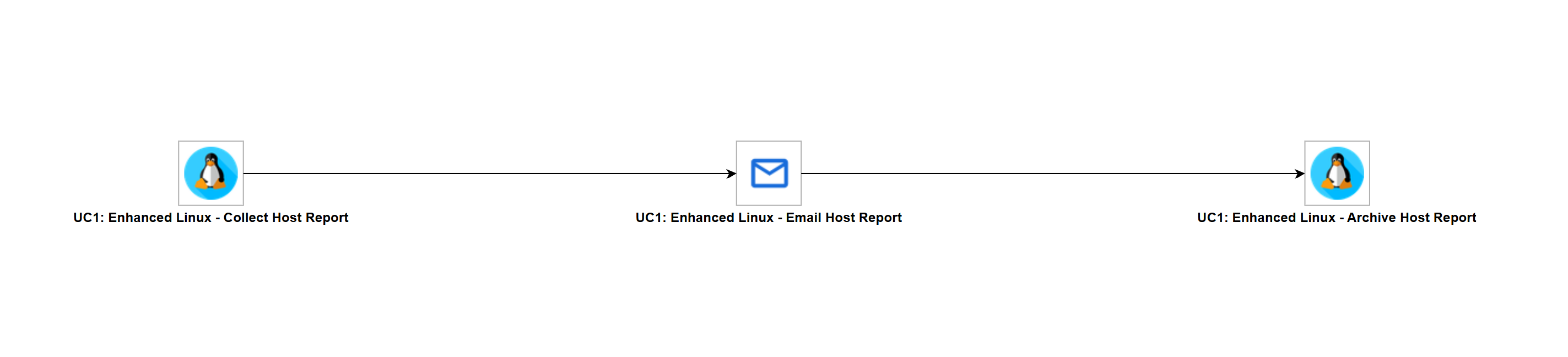
This workflow collects a configuration report from a Linux host, sends it to the stakeholders as an email attachment, and archives it on the host. An Enhanced Linux Task runs a shell script that collects the host configuration and captures the output to a report file, the UAC Utility: Email integration delivers that file to the stakeholders, and a second Enhanced Linux Task copies the report into an archive directory while appending the outcome to a history log retained across runs.
Both Enhanced Linux Tasks execute as a dedicated service account through sudo, without the Universal Agent itself running as that account. The workflow demonstrates how Enhanced Linux executes both scripts and commands on a Universal Agent for Linux, under a controlled user identity and with control over where the output of each execution is written. It also shows how the files produced on the Agent host are consumed by downstream tasks, allowing Linux workloads to participate in a broader orchestration rather than running in isolation.
Business Value
- Capability to run existing Linux commands and shell scripts from the Universal Controller without rewriting them.
- Execution of workloads under the service account they belong to, without granting that identity to the Universal Agent or distributing its credentials.
- Delivery of the output produced on a Linux host to stakeholders automatically, with no manual collection step.
- Retention of an audit trail of every run through a history log that grows across executions.
- Reuse of the files produced by a Linux workload in downstream tasks of the same workflow.
- Central scheduling and monitoring of Linux workloads alongside the rest of the automation estate.
Technical Capabilities
- Executes a shell script defined in the Universal Controller Scripts library on a Universal Agent for Linux, with Universal Controller variables resolved in the script body before execution.
- Executes a command on the same Agent, demonstrating both execution modes of the integration in a single workflow.
- Switches to a target user through sudo for both execution modes, requiring only a sudoers entry on the Agent host.
- Redirects STDOUT and STDERR to files on the Agent host while also returning the captured output to the task instance.
- Appends to an existing file instead of overwriting it, so a log accumulates one entry per workflow run.
- Resolves every host path, Agent name, sudo user, and email address from Universal Controller global variables, keeping the workflow portable across environments.
The solution shows that Linux commands and scripts do not have to remain isolated on the host that runs them, nor require the Universal Agent to impersonate the accounts that own them. Their output becomes an artifact the rest of the workflow can act on, which turns existing Linux automation into a scheduled, monitored, and auditable part of the Universal Automation Center.