


Product information "Red Hat: Openshift Jobs & Templates"
Note: This integration replaces OpenShift Jobs - SB10182
OpenShift Jobs, CronJobs, and Templates are resource types used to manage workload execution in a cluster. Jobs run tasks to completion, CronJobs schedule recurring executions, and Templates allow reusable, parameterized configurations for resource creation. This integration provides a streamlined interface to OpenShift, allowing users to create or delete resources—including Jobs, CronJobs, and Templates—directly from the Universal Controller. Users can choose between imperative (through "create") and declarative (through "apply") approaches when deploying these resources, supporting flexible workflows for automation, scheduling, and repeatable infrastructure management.
Key Features
- Deploy Job, CronJob and Template resources, either declaratively or imperatively, from local YAML files, remote URLs or UAC scripts.
- Deploy parametrized Job instances by processing existing Template objects in the cluster.
- Create one-off Job resources based on existing CronJob definitions in the cluster.
- Delete Job, CronJob and Template resources via the delete action or manually through a Dynamic Command. Job resources can also be set to be deleted automatically after completion.
- Supported authentication methods include Basic Authentication and Access Token Authentication.
- Live stream real-time updates about Kubernetes pods as they are created, modified, or terminated.
- Option to automatically or manually retrieve information, including logs, for all containers pertaining to a specific job.
What's New
Enhancements
- Added: In-Cluster Authentication method, using the pod's mounted ServiceAccount identity for clusters where the agent runs as a pod.
| Extension Name: | ue-openshift-jt |
|---|---|
| Universal Template Name: | OpenShift Jobs & Templates |
| Version: | 1.1.0 |
| Vendor: | Red Hat |
| Type: | Free |
| Compatibility : | UC/UA 7.7 and above |
| Support: | Stonebranch Certified |
Use Case 1: Hybrid OpenShift Task Orchestration with Universal Agents
Description
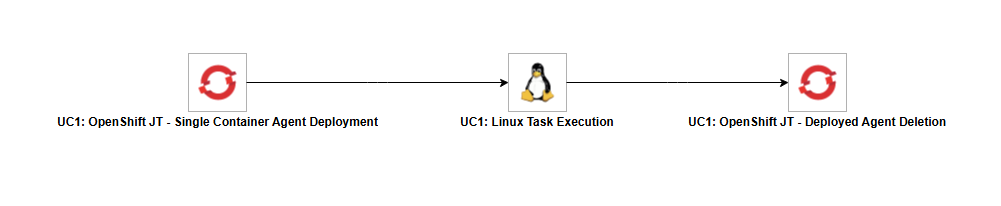
This workflow demonstrates end-to-end OpenShift job lifecycle management by externally triggering job creation, dynamically deploying Universal Agent resources, executing tasks through those agents, and maintaining clean resource states through automated cleanup. The solution showcases the ability to orchestrate any OpenShift job from external workflow systems beyond traditional containerized workloads, enabling hybrid execution models where externally-triggered OpenShift jobs provision agents for Controller-based task execution.
Business Value
- Eliminate manual OpenShift resource lifecycle management by automating external job triggering, agent deployment, task execution, and cleanup in a single orchestrated workflow
- Enable enterprise-grade external job orchestration with the ability to trigger and monitor any OpenShift job across your container infrastructure from Universal Automation Center
- Optimize resource utilization and costs through ephemeral agent deployment that provisions resources only for active tasks
Technical Capabilities
- Complete OpenShift job lifecycle orchestration including resource creation, task execution, and automated cleanup through integrated workflow components
- Dynamic Universal Agent provisioning that deploys agents on-demand within OpenShift clusters through external job triggers and integrates seamlessly with Controller task execution
- Job execution framework demonstrating the capability to execute various job types with different functionalities across the OpenShift environment
This solution transforms OpenShift resource management into a dynamic, externally-orchestrated automation system that combines the scalability of OpenShift with the flexibility of Universal Controller task execution, delivering enterprise-grade container orchestration with complete external visibility and control.
Use Case 2: Template-Driven OpenShift Job Lifecycle with Conditional Cleanup
Description
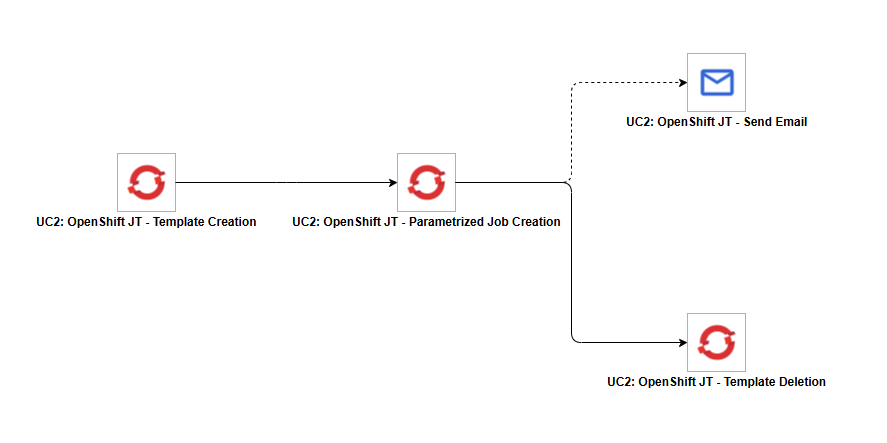
This workflow demonstrates comprehensive OpenShift template-driven job management by creating reusable templates, executing parameterized jobs from those templates, and providing intelligent outcome-based resource management. The solution showcases conditional workflow routing where job failures trigger immediate notifications while successful executions automatically restore the cluster to its original state through complete resource cleanup.
Business Value
- Eliminate manual OpenShift template and parameterized job lifecycle management by automating template creation, job generation, execution live monitoring, and outcome-based cleanup
- Accelerate incident response with immediate failure notifications while maintaining silent success operations that automatically restore cluster state
- Deliver clean-slate resource handling while preserving failed resources for troubleshooting
Technical Capabilities
- Complete template-to-job lifecycle orchestration including OpenShift template creation, parameterized job generation, and execution using the ue-openshift-jt extension
- Conditional workflow branching that sends failure notifications or performs complete resource cleanup based on job execution outcomes
- Automated cluster state restoration that deletes both jobs and templates on success, ensuring no residual resources remain in the OpenShift environment
This solution transforms OpenShift templates and job management into an intelligent, self-managing automation system that combines the flexibility of parameterized templates with outcome-aware resource lifecycle management, delivering enterprise-grade container orchestration with proactive failure handling and automatic cluster hygiene maintenance.