2026 Global State of IT Automation Report
IT Automation Trends 2026: Key Insights from the Global State of IT Automation Report
Discover the top IT automation trends for 2026, including hybrid IT orchestration, automation-as-a-service, and AI-driven workflows, based on new research from the Global State of IT Automation Report.
What the 2026 Global State of IT Automation Report Tells Us
Enterprise automation has entered a new phase — and this year's data makes that clear.
Now in its fifth year, the Global State of IT Automation Report is Stonebranch's annual benchmark study of enterprise IT automation professionals. The 2026 edition is based on a quantitative survey of over 400 respondents across IT Ops, DevOps, CloudOps, DataOps, and PlatformOps roles in enterprise organizations worldwide, conducted in Q1 2026. The findings show where organizations actually are with automation in 2026, not where vendor marketing suggests they should be.
The big picture: automation is no longer a back-office efficiency tool. It has become the operational layer that coordinates infrastructure, applications, data pipelines, and AI workflows across the modern enterprise. What started as job scheduling and task automation is now a strategic orchestration capability that spans hybrid environments, multiple cloud platforms, and increasingly, AI-driven execution.
The trends below are grounded in that survey data. Each one reflects a real shift in how organizations are building, scaling, and governing automation programs in 2026.

By the Numbers: 2026 IT Automation at a Glance

Hybrid IT is now how most organizations operate. 88% run across both cloud and on-prem environments, making consistent orchestration a basic requirement rather than something to aim for.

Platform modernization is picking up speed. 50% plan to invest in WLA/SOAP in 2026, and 69% say they are looking for more functionality, especially self-service portals, modern user interfaces, SaaS delivery, and AI workflow creation.

Orchestration is taking on a bigger role as the control layer. 89% of respondents now manage multiple automation platforms, while investments continue to grow across cloud automation, WLA/SOAP, infrastructure automation, and DevOps automation.

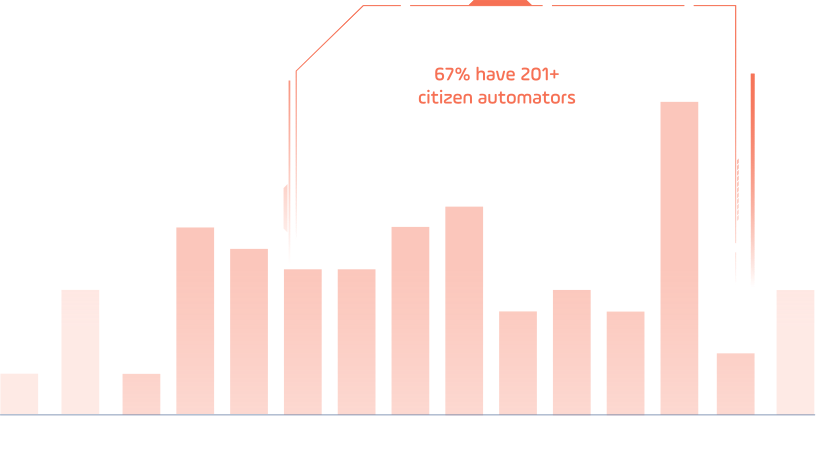
Automation is also becoming a shared service across the business. 93% have centralized teams, but those teams now support hundreds, if not thousands, of users. 67% enable more than 200 self-service automators through tools like ITSM systems, portals, and messaging platforms.

Managed file transfer (MFT) is widely connected to automation, with 90% of respondents integrating the two. Still, only 49% have fully unified workflows, which leaves room to improve visibility, recovery, and governance.

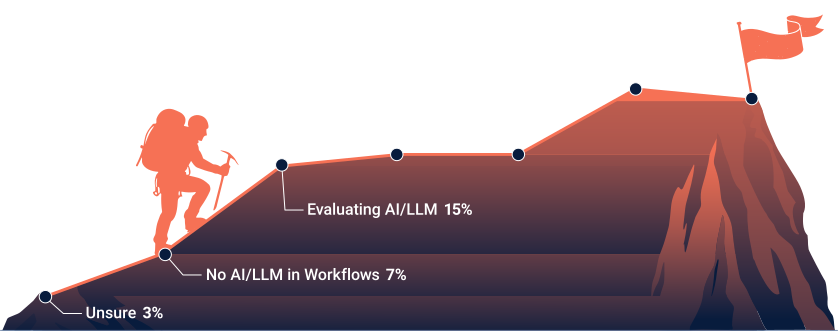
AI adoption is clearly growing, but most organizations are still in the early stages. Only 21% have reached enterprise-scale deployment, as teams work through challenges around orchestration, governance, and consistency.
Trend 1: Hybrid IT Is the Enterprise Operating Model
Hybrid IT is not a transition state. It is the destination. In 2026, 88% of survey respondents operate in hybrid IT environments that combine on-premises infrastructure with public and private cloud platforms. Only 7% run cloud-only, and just 5% remain entirely on-prem.
IT Environment Currently in Operation (2024–2026)
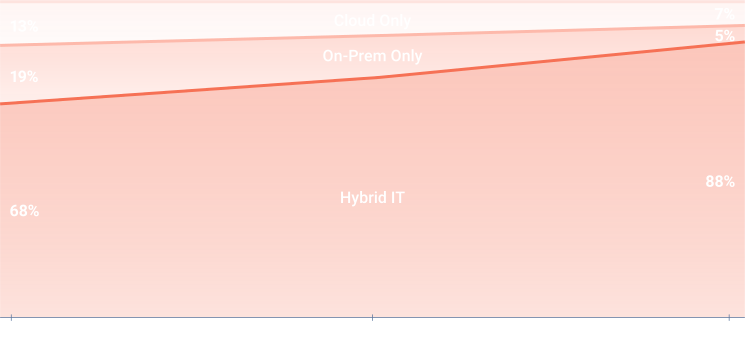
That number has been consistent enough over multiple years of this survey that it no longer surprises anyone. What has changed is why it matters.
Early hybrid strategies were largely about migration: moving workloads to the cloud while keeping some legacy systems on-prem. The focus was on integration and coexistence. Today, the priority has shifted to operational consistency. Workloads now run across:
- Public cloud platforms
- Private cloud infrastructure
- On-prem data centers
- Mainframe systems
These varying environments often appear within the same end-to-end process. Each introduces its own tooling, access patterns, and operational model.
Key Takeaway: In 2026, hybrid IT success largely hinges on consistent orchestration across infrastructure boundaries.
Without centralized orchestration, automation fragments. Teams build and run workflows within individual environments but lose visibility the moment a process crosses a boundary. Alert fatigue increases. Recovery times lengthen. Compliance gaps emerge.
The organizations managing hybrid IT most effectively are those that standardize on orchestration platforms providing end-to-end workflow visibility, centralized governance, and event-driven execution, regardless of where a workload runs.
Trend 2: WLA/SOAP Investment Is Accelerating, Not Plateauing
The 2026 investment data identify four dominant categories of automation spending — what we call the ‘Big Four’:
- Cloud automation: 64% (up 21% since 2024)
- WLA/SOAP: 50% (up 14% since 2024)
- Infrastructure automation: 49%
- DevOps automation: 49%
These four categories represent the core of what enterprises are building and expanding right now.
Top Automation Technology Investment Priorities in 2026
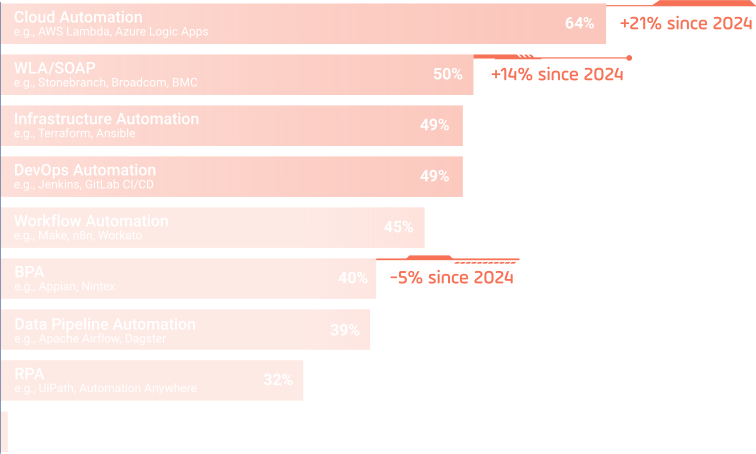
The WLA/SOAP growth rate deserves specific attention. Workload automation has existed in enterprise IT for decades. A 14% jump in two years for a mature technology category is unusual. It signals something more fundamental: organizations are recognizing that neither cloud-native tools nor infrastructure automation platforms were designed to orchestrate end-to-end processes across fragmented, multi-cloud, multi-platform environments.
Key Takeaway: Rising WLA/ SOAP investments show orchestration has become the connective layer that links front- and back-office technologies, data, and processes into governed workflows.
Cloud-native tools are excellent within their native environment. They fall short when a workflow spans that environment and something else. WLA/SOAP platforms were designed for exactly that coordination problem — and as hybrid complexity grows, demand for that coordination capability grows with it.
Trend 3: Enterprise Orchestration is Becoming the Automation Control Plane
Modern enterprises have built out multiple categories of automation tools over the years. Cloud automation handles provisioning. DevOps pipelines manage deployment. Infrastructure automation manages configuration. Data automation manages pipelines. File transfer tools move data between systems. Each category solves a real problem.
The challenge is that those tools, deployed independently, create operational silos. There is no unified view of what is running, what failed, what depends on what, or whether SLAs are being met across the full workflow lifecycle.
This is where service orchestration and automation platforms (SOAPs) are playing an increasingly strategic role. The SOAP software category is an evolution of traditional workload automation (WLA), introduced to the market by Gartner at the start of this decade. SOAPs don’t replace specialized automation tools. They coordinate them. An enterprise SOAP connects infrastructure automation, application workflows, cloud operations, data pipelines, and service management processes into a single operational framework, with centralized monitoring, standardized execution, cross-system triggers, and consistent governance.
Key Takeaway: Service orchestration and automation platforms increasingly serve as the operational backbone connecting multiple automation technologies
Think of it as the control plane for automation, a coordination layer that sits above individual tools and translates distributed automation efforts into coherent, centrally managed workflows supported by:
- Unified monitoring and observability
- Standardized workflow execution
- Cross-system automation triggers
- Consistent governance across automation domains
As automation portfolios grow in size and complexity, orchestration becomes the mechanism that keeps distributed automation efforts aligned and manageable.
Trend 4: Multi-Tool Environments Are the Norm, and Rationalization Is Underway
89% of survey respondents manage multiple WLA/SOAP applications. This is not a recent problem. Multi-tool environments emerge organically from acquisitions, departmental autonomy, and years of incremental technology decisions made by different teams with different priorities.
Enterprise-Grade WLA/SOAP Tool Usage in 2026
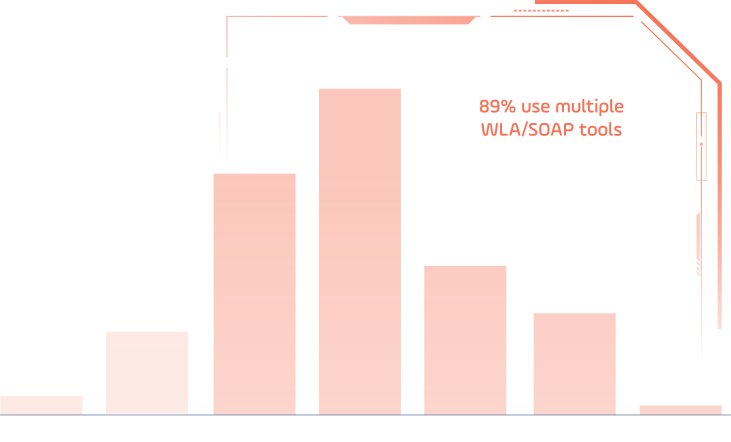
The operational cost is real and well understood: multiple monitoring consoles, inconsistent alerting frameworks, different audit trail formats, and no single view of end-to-end workflow execution. When a critical process fails at the handoff point between two platforms, the response time typically reflects the visibility gap.
Planned Addition or Replacement of WLA Technologies in 2026
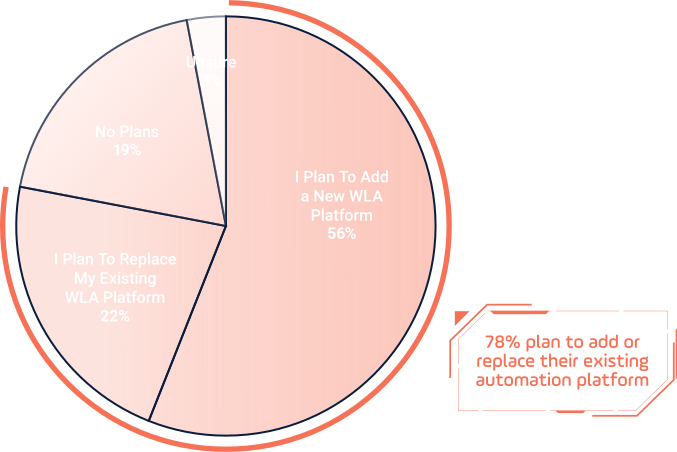
78% of organizations plan to either add (56%) or replace (22%) an automation platform in the near term. This is the portfolio transition point the industry has been building toward. Many organizations adding new platforms are doing so with consolidation in mind over the medium term. In the meantime, however, the result is growing tool sprawl, and coexistence is becoming the default operating model for enterprise automation.
For organizations navigating this reality, the evaluation criterion that matters most isn’t which platform has the best native automation capabilities in isolation. Rather, it’s which platform can serve as an enterprise orchestration hub — one that provides centralized visibility and governance across a coexistence environment while the transition process plays out over time.
Trend 5: Platform Modernization Is Being Driven by Functionality, Not Cost
For most of enterprise software's history, cost reduction was the primary business case for technology investment. Automation was no different. You could almost write the ROI model in your sleep: automate X processes, save Y hours, multiply by labor cost.
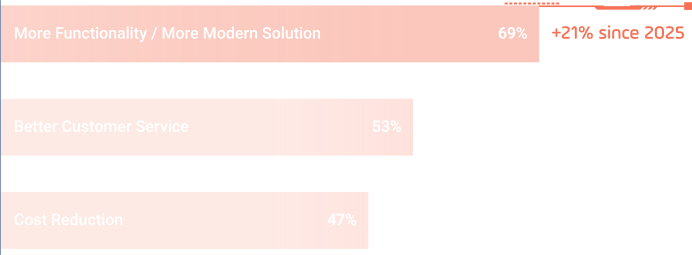
That model has shifted. In 2026, 69% of organizations cite "more functionality / more modern solution" as the primary driver for platform change, up 21% since 2025. Cost reduction has dropped to third place at 47%.
Motivations to Change Automation Toolset in 2026
The features driving modernization decisions are consistent with a broader shift toward enterprise-wide adoption:
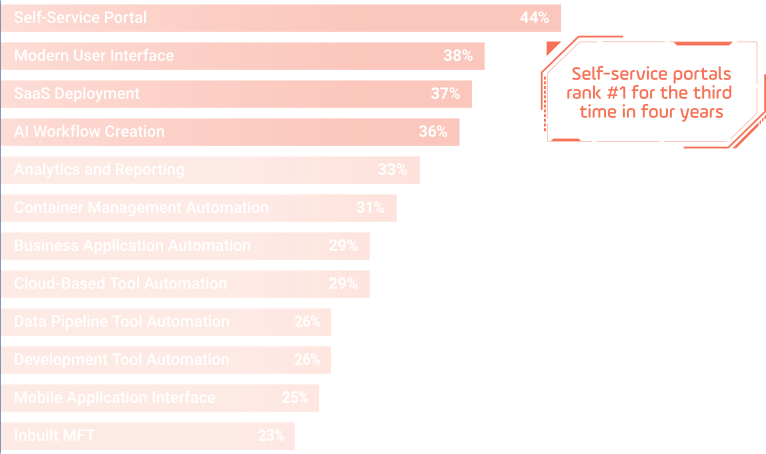
- Self-service portals: 44% — the top feature for the third consecutive year
- Modern user interfaces: 38%
- SaaS deployment: 37%
- AI workflow creation: 36%
Features and Capabilities Sought in a Modern IT Automation Platform in 2026
Legacy automation platforms were built for small teams of specialists. They require significant expertise to operate and are difficult to extend beyond the core IT team. Modern enterprise environments need automation to support a much broader set of users (including developers, cloud engineers, data teams, and business users), not just automation specialists.
Key Takeaway: Modern automation platforms prioritize usability, accessibility, and enterprise-wide enablement.
Self-service portals topping this list for three years running is not a coincidence. It reflects a fundamental change in what automation platforms need to deliver: not just better execution capabilities for experts, but accessible tooling that scales automation usage across the organization safely and efficiently.
Trend 6: Automation is Becoming a Governed Enterprise Service, Delivered at Scale
Automation demand is expanding rapidly across organizations. Nearly every enterprise surveyed (93%) now operates a centralized automation team, yet these teams remain relatively small.
At the same time, the number of automation users continues to grow. 67% of organizations report having 201 or more self-service automation users across development, cloud operations, data engineering, and business teams. That is a fundamental change in operational scale. A centralized team of specialists cannot serve hundreds of users by building and operating every workflow themselves — not without growing the team at a rate that would quickly outpace hiring capacity.
Self-Service Automation End-Users in 2026
The resolution is not headcount. It’s a shift from an expert-led delivery model to an automation-as-a-service model. Rather than executing workflows for every team, centralized automation groups are building governed frameworks that enable users to automate safely on their own. This typically involves:
- Reusable workflow templates that encode best practices
- Role-based access controls (RBAC) that govern what users can access and execute
- Standardized automation patterns that prevent sprawl
- Centralized monitoring and compliance controls
These structures allow organizations to expand automation usage while maintaining the operational consistency and security that centralized oversight provides. The automation-as-a-service model is how teams scale without chaos.
Key Takeaway: Successful automation programs scale by combining self-service access with strong governance frameworks.
Trend 7: Users Access Automation Through the Tools They Already Use
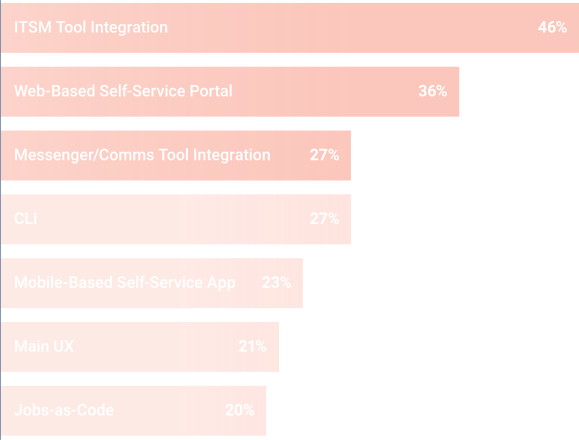
How end users access automation workflows has changed significantly. When organizations were asked how their teams interact with their WLA/SOAP platform, the native interface came in last at just 21% — down 14% from 2025.
What leads instead:
- ITSM tool integration (ServiceNow, Jira, etc.): 46%
- Web-based self-service portals: 36%
- Messaging and communications tools (Teams, Slack): 27%
- CLI: 27%
Methods to Access Self-Service Automation in 2026
This is a healthy architectural signal. Automation is becoming invisible infrastructure. Rather than requiring teams to context-switch into a dedicated specialist console, organizations are embedding automation access directly into the tools people use every day — their ITSM system, their messaging platform, their internal web portal.
Key Takeaway: Automation scales faster when users can manage it through familiar interfaces like ITSM tools, portals, and chat platforms.
Practically, this means automation platforms need robust API-first architectures and pre-built integrations with ITSM and collaboration tools. The interface is no longer the product. The integration surface is.
Trend 8: Integration Depth Is the New MFT Differentiator
Managed file transfer (MFT) remains a foundational component of enterprise automation. 90% of organizations connect their MFT tools with their automation platform. The problem is how many of those connections stop short of full integration.
MFT Integration with WLA/SOAP Workloads in 2026
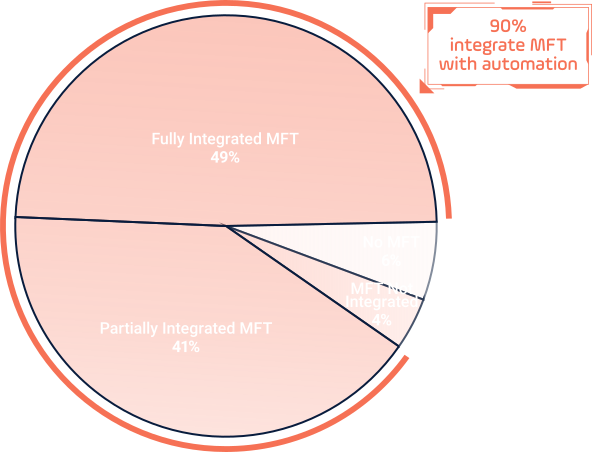
Only 49% report fully integrated MFT workflows — meaning file transfers are embedded directly into orchestration workflows rather than managed separately. 41% have partial integration, where some MFT activity feeds into broader workflows, but monitoring, recovery, and governance remain disconnected.
That gap matters for reliability. When a file transfer fails in a partially integrated environment, recovery depends on someone noticing the failure, identifying the failure point, and manually intervening across two separate systems. In a fully integrated environment, the orchestration platform detects the failure, triggers the appropriate recovery workflow, and maintains a complete audit trail — automatically.
Beyond failed transfer scenarios, full integration allows organizations to treat data movement as part of a broader automated process. This enables:
- Cohesive monitoring of workflows and transfers
- Automated recovery from transfer failures
- Centralized governance of data movement
- Tighter coordination with downstream processes
As hybrid data flows grow more complex — especially across cloud platforms and B2B environments — the 51% of organizations still running partial or disconnected MFT integration are carrying operational and compliance risk that fully integrated orchestration would eliminate.
Key Takeaway: Integrated MFT orchestration improves resilience, observability, and governance across automated workflows.
Trend 9: AI Adoption Is Growing, but Enterprise Scale Remains the Exception
No trend generates more coverage than AI. And the 2026 data provide a useful correction to some of the more breathless predictions in the market.
AI and large language model (LLM) tasks are increasingly appearing in automation workflows. But only 21% of organizations currently run AI workflows at enterprise scale. That number is worth sitting with. 79% of organizations have not yet achieved enterprise-scale AI workflow deployment.
AI/LLM Task Integration Into Automation Workflows in 2026
The reasons are practical, not philosophical. Organizations moving AI from pilot to production consistently encounter the same set of challenges:
- Integrating AI services with existing automation workflows without rebuilding them from scratch
- Establishing governance and compliance controls for AI-generated outputs
- Developing in-house expertise around AI tooling and prompt engineering
- Managing AI-introduced latency in time-sensitive process chains
These are orchestration problems, not AI problems. Adding an AI capability to an existing workflow requires the workflow infrastructure to support it — with proper monitoring, human-in-the-loop approval chains for low-confidence outputs, exception handling, and auditability. That infrastructure is built into enterprise orchestration platforms. It doesn’t exist in most AI vendor tools or experimental frameworks.
Key Takeaway: Scaling AI automation requires operational frameworks that integrate AI tasks into governed enterprise workflows.
The 21% who’ve reached enterprise scale are not distinguished by better AI models. They’re distinguished by better operational foundations underneath those models.
Trend 10: AI Workflow Automation Is Either Enterprise-Grade, or It Is Not
When organizations embed AI and LLM tasks into automation workflows, the choice of tooling splits into two very different operational realities. The difference comes down to whether the platform is built for enterprise production.
Today’s landscape reflects that split. Organizations are using a mix of tools to operationalize AI in automated processes, led by:
- AI vendor-created tools: 61%
- WLA/SOAP platforms: 58%
- Custom-built frameworks: 54%
Platforms Used to Embed AI/LLM Tasks in Automation Workflows in 2026
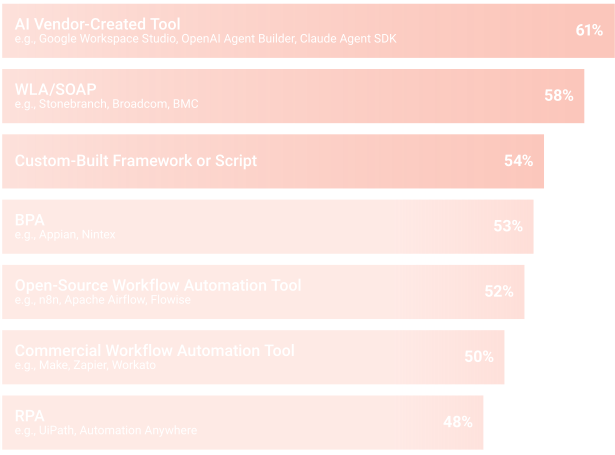
WLA/SOAPs ranking second is architecturally significant, and here’s why: AI vendor-created tools, custom-built frameworks, and open-source workflow automation tools (not to be confused with workload automation tools) are generally not designed with hardened enterprise-production requirements in mind. They work well for experimentation and for smaller, team-centric workflows. They don’t natively provide the coordination capabilities that enterprise production demands.
Key Takeaway: Enterprise AI automation requires more than AI access — it requires orchestration that brings governance, auditability, exception handling, and cross-system coordination to every workflow.
That gap becomes clear when you look at what a real enterprise AI process actually involves.
Consider this realistic enterprise AI workflow scenario: a business event triggers an LLM task, the output must be passed to a downstream data pipeline, a human approval step is triggered if the confidence score falls below a defined threshold, and the entire process must generate a complete, auditable trail. That scenario requires:
- Heterogeneous execution environment coordination
- Dependency management across systems
- SLA enforcement
- Human-in-the-loop approval workflows
- Exception handling and automated recovery
- End-to-end auditability and centralized governance
AI vendor tools are optimized for automation within their own ecosystems. That’s a feature, not a flaw — but it also defines their limit. That’s where orchestration platforms come in. They’re designed to connect systems, manage complexity, and ensure that workflows run reliably at scale.

Key Takeaways from the 2026 Global State of IT Automation Report
- 88% of enterprises operate hybrid IT environments. Orchestration platforms are the mechanism for managing that complexity with centralized visibility and governance.
- WLA/SOAP investment is accelerating, up 14% since 2024. Organizations recognize that neither cloud-native nor infrastructure automation tools were built to coordinate end-to-end hybrid workflows.
- Enterprise orchestration platforms are functioning as control planes that connect infrastructure, data pipelines, applications, and AI into governed workflows.
- Automation is expanding to broader user bases. 67% of organizations support 200+ self-service automation users, and governance frameworks are essential to scaling that safely.
- Platform modernization is now driven by usability and enterprise-wide enablement. Self-service portals have led the modernization wish list for three consecutive years.
- Only 21% have reached enterprise-scale AI workflow deployment. The gap is an orchestration and governance challenge, not an AI capability problem.
- AI workflow automation platforms are splitting into enterprise-grade and experimental tiers. WLA/SOAP platforms rank second in adoption because they bring the operational infrastructure that other tools lack.
Final Thoughts: Automation Becomes the Enterprise Execution Layer
The 2026 Global State of IT Automation Report describes a clear transformation. Automation has moved from efficiency tool to operational infrastructure. It’s now the layer that coordinates infrastructure, applications, data pipelines, and AI workflows across the modern enterprise. The organizations that are advancing furthest are not necessarily spending more on automation. They’re orchestrating it better.
Hybrid IT is the operating reality. AI workflows are entering production. Self-service is expanding the automation user base. MFT is uniting with broader orchestration frameworks. The tools for doing all of this exist. The question in 2026 is whether the platforms supporting those capabilities are ready for enterprise-grade scale.
Download the full 2026 Global State of IT Automation Report to explore the complete data, trend analysis, and expert recommendations.
Frequently Asked Questions About IT Automation Trends for 2026
What is IT automation?
IT automation is the use of software platforms to automatically execute IT tasks, workflows, and processes across infrastructure, applications, and services. Modern IT automation platforms go beyond task execution to orchestrate end-to-end workflows across hybrid environments, cloud services, data pipelines, and enterprise applications, with centralized monitoring and governance.
What is a SOAP in workload automation?
A service orchestration and automation platform (SOAP) is an enterprise automation category formally defined by Gartner that coordinates workflows across multiple automation domains. An evolution of traditional workload automation (WLA) tools, SOAPs connect infrastructure automation, DevOps pipelines, cloud operations, data pipelines, and service management processes into a unified operational framework. They act as a control plane for distributed automation environments.
What is the difference between workload automation and workflow automation?
Workflow automation streamlines business processes within apps, such as approvals and notifications. Workload automation (WLA) tools, especially as they’ve evolved into service orchestration and automation platforms (SOAPs), operate at a higher level. SOAPs coordinate complex workflows across systems, infrastructure, and tools, acting as the control layer for enterprise automation.
In short, workflow automation connects tasks within a process, while workload automation orchestrates those processes end-to-end across the enterprise.
Why is hybrid IT automation important?
88% of enterprises now operate hybrid IT environments that combine on-premises systems with public and private cloud infrastructure. In these environments, workflows regularly cross system boundaries. Without centralized orchestration, automation fragments across platforms, visibility gaps emerge, and recovery from failures becomes slower and more manual. Hybrid IT automation provides the consistent execution, monitoring, and governance that cross-environment workflows require.
What is automation-as-a-service?
Automation-as-a-service is an operating model in which a centralized team enables others to build and run their own automation. Instead of creating every workflow, the team provides tools like self-service portals, reusable templates, and APIs. This approach allows developers, cloud teams, data teams, and business users to manage their own automated processes, while the central team maintains governance, security, and operational standards across the organization.
How is AI used in IT automation?
AI is increasingly integrated into automation workflows to support tasks such as data processing, decision support, and workflow generation. Organizations often use orchestration platforms to embed AI tasks into broader automated workflows with monitoring and governance controls.
AI and LLM tasks are increasingly integrated into automation workflows for use cases including data processing, content generation, decision support, anomaly detection, and intelligent routing. Enterprise-grade AI automation requires the AI task to be embedded within a broader orchestration framework — with proper dependency management, SLA enforcement, human-in-the-loop approval (where needed), exception handling, and end-to-end auditability. Only 21% of organizations currently operate AI workflows at enterprise scale, primarily due to integration and governance challenges.
What are the most important IT automation trends for 2026?
According to the 2026 Global State of IT Automation Report, the defining trends are:
- Hybrid IT is the norm: Most organizations run across cloud and on-prem, requiring consistent orchestration.
- Orchestration is the control plane: SOAPs are connecting tools, workflows, and systems end to end.
- Automation is scaling across teams: Self-service is expanding usage beyond IT to developers, data, and business users.
- Modernization is capability-driven: Organizations are prioritizing usability, SaaS, and AI-ready platforms.
- Multi-tool environments are common: Teams are managing and rationalizing multiple automation platforms.
- Automation is delivered as a service: Central teams enable others through templates, portals, and governance.
- Access is embedded in everyday tools: Users interact with automation through ITSM, portals, and messaging apps.
- Integration depth matters for MFT automation: MFT and other tools are being fully embedded into workflows.
- Adoption of AI in automated workflows is growing: But most organizations have not yet reached enterprise scale.
- Enterprise AI automation requires orchestration: Scaling AI depends on governance, coordination, and reliability across systems.